Physicist: To a stunningly good approximation: zero.
The big difference between dark matter and ordinary matter is that dark matter is “aloof” and doesn’t interact with other stuff. Instead, it cruises by like “ghost particles”. Matter on the other hand smacks into itself and clumps together. The big commonality is that both of them create and are affected by gravity.
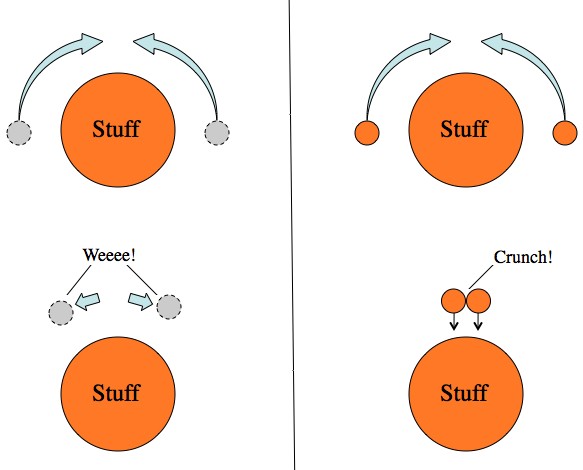
If you have a big ball of matter (doesn’t matter what kind), then both ordinary and dark matter will be pulled by its gravity. However, there’s no reason for the dark matter to ever fall out of orbit since there’s nothing around to stop its motion. Normal matter tends to “get in its own way”.
In fact, if it weren’t for the gravitational influence of dark matter, we would have no reason to suspect its existence at all. Because dark matter doesn’t clump it stays really spread out and forms one big, roughly spherical, cloud around the galaxy. Matter has more of a “big-clump-or-nothing” deal going on. If you start with a big cloud of ordinary matter, then eventually (it can take a while) you’ll have one or two huge chunks (stars, binary stars, that sort of thing) and the few crumbs that escape tend to end up clumping together themselves (planets, moons, comets, your mom, etc.). If you feel like impressing people at your next science party, this is called “accretion“.
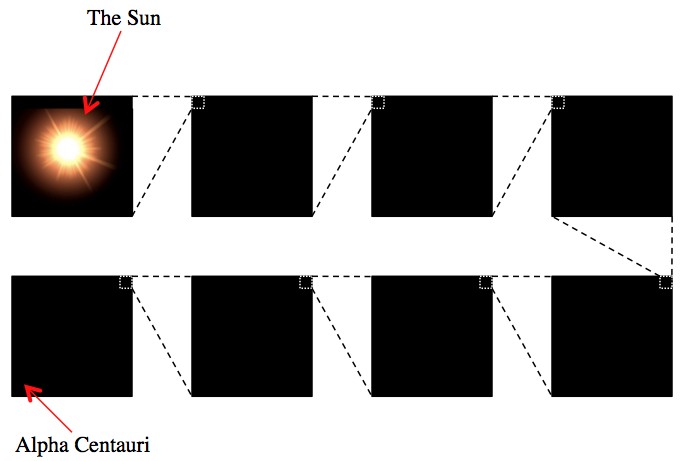
Any attempt to picture the Sun and nearby stars to scale look like nothing. This is an attempt where every square is 10 times the size of the previous square (1000 times the volume). Point is, when ordinary matter concentrates it really, really, really concentrates.
In the above picture the dark matter is spread out uniformly. Overall there’s a lot more of it (about 10 times as much, give or take), but here in the solar system the balance is tipped overwhelmingly in favor of ordinary matter. But more than that, since dark matter is spread evenly (and thinly) all around us, it doesn’t pull in any particular direction. There’s about the same amount in every direction you point, so there’s very little net pull in any direction. Until you start considering galactic scales at least.
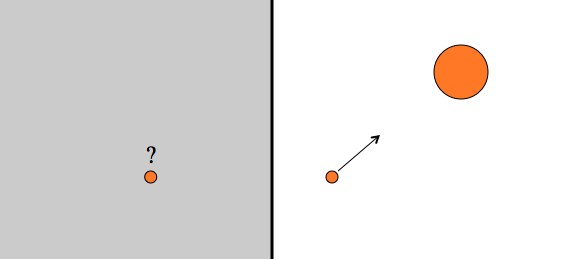
Ordinary matter clusters in big blobs, so when it pulls it tends to pull in one direction (right). Dark matter does pull, but it pulls on every particle evenly in every direction, which is a lot like not pulling at all (left).
If you do consider things on a galactic scale (~100,000 lightyears), then there’s more dark matter in the direction of Sagittarius (in December this is overhead around midnight). Technically, since we’re most of the way to the edge of the galactic disk, and the center of the galaxy is behind the stars in Sagittarius, most of the stuff in the Milky Way is more or less in that direction. That imbalance makes the Sun and all the other nearby stars (“nearby” = “visible to the eye”) orbit the galaxy, but it also helps Earth and everything else around us do the same. Astronauts in orbit appear weightless because their ship and their bodies are both orbiting the Earth. They are both in “free-fall”. Similarly, the Earth, the Sun, and even everything in our stellar neighborhood are all in free-fall around the galaxy. So while the preponderance of dark matter in the galaxy does cause the solar system to slowly sweep out a seriously huge circle (the “galactic year” is about 250 million Earth years), it does not cause things in the solar system to move with respect to each other.
Hopefully, dark matter has more tricks than just gravity. If it has no other way of interacting with stuff, then that makes it really difficult to study. We can study things like stars, rocks, and puppies because they’re all “strongly interacting”. Shine light on them? Sure. Poke them? Why not. But dark matter (whatever it is) is light-proof and poke-proof, and that’s deeply frustrating.



Pingback: Quickie: materia întunecată are un efect foarte mic la scară planetară – Manuel Cheța