Physicist: Scientists can generally answer “medium complicated” questions. The really hard ones are too damn hard, and the really simple ones are often “just the way things are”. Or they may be really, really difficult questions in disguise. You’ve found one of the fundamental questions that no one seems to have a good answer for. We also don’t know why the mass, , we use when talking about inertia (as in
) is the same as the mass we use when talking about gravity (as in
). The best theory I’ve ever heard is that matter is actually made of bunched up “knots” of space-time, and even that isn’t a terribly good a theory.
The second half of your question we do have an answer for, it’s just a little mind bending and hard to picture. What heavy objects are bending is space itself. The way you detect space (follow me here) is with rulers or stretched out strings, or stuff like that. Anything that measures distance. Near heavy objects the distance between points is greater than you would expect, and you can use this fact to detect and measure the stretching of space.
The usual trick when trying to picture higher dimensional space is to knock off a couple of dimensions, and picture that instead. 3 dimensions is too complicated, and 1 is stupid, so here’s 2!
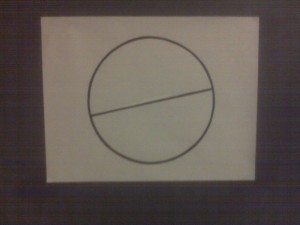
A circle and its diameter in flat space. Here D=6.5'', C=20.4'', and 20.4/6.5=3.13 ≈π.
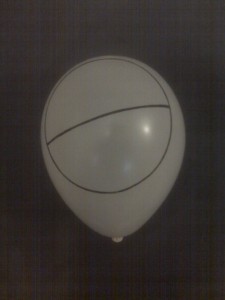
A circle and its diameter in curved space. Here D=7.2'', C=20.4'', and 20.4/7.2=2.83<π
Take the circumference, , and the diameter,
. You’ll notice that on paper (flat space)
. Which makes sense, since that’s the definition of
. However, on the balloon (curved space)
, since the diameter is longer. This effect is huge (infinite) for things like black holes, but for an object like the Earth the effect is tiny (ignore the hell out of it). The stretching of space caused by the Earth’s gravity (well… that is Earth’s gravity) increases the diameter of the Earth by about 18mm.
That is, the diameter you get by measuring the equator and dividing by (
) is the “flat space diameter”, the diameter you get by physically dropping a rope through the planet is the true, “curved space diameter”, and the difference between these two is 18mm.


Pingback: Q: How far away is the edge of the universe? « Ask a Mathematician / Ask a Physicist
Hi, I have a question regarding Space warping. Per Einstein, “space-time fabric” gets warped by massive objects and if these massive objects are twisting / rotating in space-time, then they could drag space-time along with them. What I would like to know is – isn’t space enveloping these objects all around? In other words, instead of imagining these objects to be located “on” space-time, shouldn’t we think of them as being enveloped by space-time in every possible direction, in which case, they should “warp”/”dent” space-time in all directions and not just on one side which means, for all intents and purposes, there are no dents ergo no gravity?
I’m not sure I understand this question.
While the warping of spacetime is certainly symmetric, if you’re near a star or planet or whatever, it’s still on just one side of you.
Regarding the question: How does mass warp [curve] space ? Could it be as simple as a massive object [like a planet or star] simply displacing space . The nuclei of the planet’s atoms would be responsible for the displacement of space . Hence a planet of higher density would warp space more than a planet of lower density [assuming both planets occupied the same volume]. The displaced space simply curves away from the planet . Space doesn’t appear to be empty if it accounts for most of the mass of the universe .
Unfortunately the math doesn’t work out a cleanly as that, but I don’t have a particularly good intuitive argument against it.
Among other things, energy also creates gravity, but doesn’t really take up space, and particles themselves (weirdly enough) don’t really have a “size”.
I’m an older dude with no professional training, but an electrician; purely by accident and determination. My question is: If in fact our universe began as a huge explosion that created space and matter simultaneously, why is it necessary to further confuse the mystery with time? To me time is a contrivance created by man to understand a bit better how long it takes to get from one point to another, not a necessity. If space on the other hand is actually physical as the Higgs is thought to be, there may be a problem. Until just a few hundres years ago, time was looking at sunrise, sunset and a stick in the ground to calculate the middle hours? At night, you slept until tiredness wore off from the previous day. Chances are we will not likely populate other solar systems for many generations and centuries, if ever? My thoughts are, we had best try finding ways to preserve this planet, rather than fool around with a universe we will physically never touch. And this while there still may be time.