Physicist: With very few exceptions, yes. What we normally call “random” is not truly random, but only appears so. The randomness is a reflection of our ignorance about the thing being observed, rather than something inherent to it.
For example: If you know everything about a craps table, and everything about the dice being thrown, and everything about the air around the table, then you will be able to predict the outcome.

Not actually random.
If, on the other hand, you try to predict something like the moment that a radioactive atom will radioact, then you’ll find yourself at the corner of Shit Creek and No. Einstein and many others believed that the randomness of things like radioactive decay, photons going through polarizers, and other bizarre quantum effects could be explained and predicted if only we knew the “hidden variables” involved. Not surprisingly, this became known as “hidden variable theory”, and it turns out to be wrong.
If outcomes can be determined (by hidden variables or whatever), then any experiment will have a result. More importantly, any experiment will have a result whether or not you choose to do that experiment, because the result is written into the hidden variables before the experiment is even done. Like the dice, if you know all the variables in advance, then you don’t need to do the experiment (roll the dice, turn on the accelerator, etc.). The idea that every experiment has an outcome, regardless of whether or not you choose to do that experiment is called “the reality assumption”, and it should make a lot of sense. If you flip a coin, but don’t look at it, then it’ll land either heads or tails (this is an unobserved result) and it doesn’t make any difference if you look at it or not. In this case the hidden variable is “heads” or “tails”, and it’s only hidden because you haven’t looked at it.
It took a while, but hidden variable theory was eventually disproved by John Bell, who showed that there are lots of experiments that cannot have unmeasured results. Thus the results cannot be determined ahead of time, so there are no hidden variables, and the results are truly random. That is, if it is physically and mathematically impossible to predict the results, then the results are truly, fundamentally random.
What follows is answer gravy: a description of one of the experiments that demonstrates Bell’s inequality and shows that the reality assumption is false. If you’re already satisfied that true randomness exists, then there’s no reason to read on. Here’s the experiment:
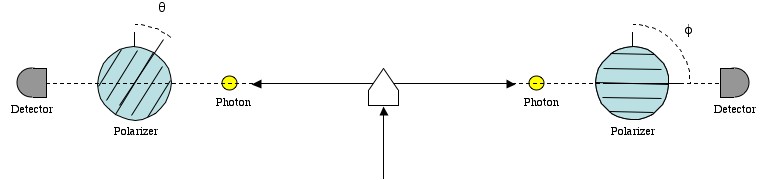
The set up: A photon is fired at a down-converter, which converts it into two entangled photons. These photons then go through polarizers that are set at two different angles. Finally, photo-detectors measure whether a photon passes through their polarizer or not.
1) Generate a pair of entangled photons (you can do this with a down converter, which splits one photon into an entangled pair of photons).
2) Fire them at two polarizers.
3) Randomly change the angle of the polarizers after the photons are emitted. This prevents information about one measurement to affect the other, since that would require that the information travels faster than light.
4) Measure both photons (do they go through the polarizers (1) or not (0)?) and record the results.
The amazing thing about entangled photons is that they always give the same result when you measure them at the same angle. Entangled particles are in fact in a single state shared between the two particles. So by making a measurement with the polarizers at different angles we can measure what one photon would do at two different angles.
It has been experimentally verified that if the polarizers are set at angles and
, then the chance that the measurements are the same is:
. This is only true for entangled photons. If they are not entangled, then
, since the results are random. Now, notice that if
and
, then
. This is because:
We can do two experiments at 0°, 22.5°, 45°, 67.5°, and 90°. The reality assumption says that the results of all of these experiments exist, but unfortunately we can only do two at a time. So C(0°, 22.5°) = C(22.5°, 45°) = C(45°, 67.5°) = C(67.5°, 90°) = cos2(22.5°) = 0.85. Now based only on this, and the reality assumption, we know that if we were to do all of these experiments (instead of only two) then:
C(0°, 22.5°) = 0.85
C(0°, 45°) ≥ C(0°, 22.5°) + C(22.5°, 45°) -1 = 0.70
C(0°, 67.5°) ≥ C(0°, 45°) + C(45°, 67.5°) -1 = 0.55
C(0°, 90°) ≥ C(0°, 67.5°) + C(67.5°, 90°) – 1 = 0.40
That is, if we could hypothetically do all of the experiments at the same time we would find that the measurement at 0° and the measurement at 90° are the same at least 40% of the time. However, we find that C(0°, 90°) = cos2(90°) = 0 (they never give the same result).
Therefore, the result of an experiment only exists if the experiment is actually done.
Therefore, you can’t predict the result of the experiment before it’s done.
Therefore, true randomness exists.
As an aside, it turns out that the absolute randomness comes from the fact that every result of every interaction is expressed in parallel universes (you can’t predict two or more mutually exclusive, yet simultaneous results). “Parallel universes” are not nearly as exciting as they sound. Things are defined to be in different universes if they can’t coexist or interact. For example: in the double slit experiment a single photon goes through two slits. These two versions of the same photon exist in different universes from their own points of view (since they are mutually exclusive), but they are in the same universe from our perspective (since we can’t tell which slit they went through, and probably don’t care). Don’t worry about it too much all at once. You gotta pace your swearing.
As another aside, Bell’s Inequality only proves that the reality assumption and locality (nothing can travel faster then light) can’t both be true. However, locality (and relativity) work perfectly, and there are almost no physicists who are willing to give it up. Except for Bohm, who’s an ass.



Your gravy is lumpy. Don’t use so much flour.
The answer did not include examples of chaos (nonlinear dynamics) which, while technically deterministic, provide ‘random’ results regardless of how well initial conditions are known.
Still, nice answer, especially with regard to quantum theory.
I think the swearing at Bohm is uncalled for. Skeptics of a standard paradigm should exist and continually be looking for a break in the standard paradigm. Also, I believe Bohm did most of his very original and interesting work before Bell derived his inequalities. If being wrong is a crime then most theorists would be in the klink.
Thanks kindly, and fair enough. In a chaotic system the predictions do get better, the better your measurements are (reducible randomness). The irreducible component comes in when your measurements run up against Heisenberg uncertainty, or when the evolution of your system is (eventually) overwhelmed by quantum effects. But this is just another way of talking about the quantum randomness in the post.
I mostly think that Bohm is an ass based on his stubbornness and his personal creepiness. He’s only a criminal according to McCarthy.
I think a more useful way to talk about randomness is “uncertainty”. There are different kinds of uncertainty, and thus different kinds of randomness. Uncertainty about air currents and temperature and the exact velocity of coins and dice are what make those things random. Under controlled conditions, that uncertainty can be eliminated, and so those things aren’t *always* random. A lot of binary quantum events (like polarizers) are more about indexical uncertainty (from the perspective of MWI)–the uncertainty we have about what part of the universe we’re in. So “uncertainty” doesn’t work to explain quantum randomness in the Copenhagen interpretation.
I think this is a pretty good way to explain it to a general audience.
Pingback: Q: What is the meaning of the term “random”? Can thinking affect the future? « Ask a Mathematician / Ask a Physicist
Uncertainty and randomness are not the same thing. Probablistic events have uncertainty associated with them e.g.: No one can predict exactly when a specific radioactive nuclide will decay (uncertainty) but the decay of these nuclides is a strictly governed probablistic function not a random one. There’s exactly a 50% chance it will decay within it’s half-life period for example.
A random event can’t be assigned any probability. A truly random event wouldn’t have any greater or lesser chance of occurring by any parameter (time, conditions, interactions etc).
I don’t know of any natural process that’s truly random (unbounded and completely indeterminate).
Don’t expect to find one!
It’s not possible to create a function (probability distribution or otherwise) that is uniform over all numbers. If the definition of random is: “absolutely no tendency to happen more at any time or place”, then nothing can be random.
Well, boy I feel dumb here:
“It’s not possible to create a function…that is uniform over all numbers”
but isn’t f(x) = 5 uniform over all values of x — all numbers? I agree for probability distributions because uniform probabilities in a distribution would approach 0 as the number of outcomes approached infinity, but *any* function? Am I not understanding the term “uniform” ?
That’s my bad. You’re exactly right. Your understanding of “uniform” is perfect.
I’ve been spending too much time only considering L1 functions.
Hi, I think this demonstration has multiple issues.
1. To quote Wikipedia, “Experimental results have demonstrated that effects due to entanglement travel at least thousands of times faster than the speed of light.” This conflicts with the presumption made in step 3.
2. The impossible chance of 40% only exists when you do impossible experiments.
3. To prove to cause a random effect in the real world, one must affect deterministic objects and change their ways randomly. Otherwise the world is perfectly deterministic with some state-unknown particles. And when these particles come in contact with the world, all results and therefore the world are deterministic, just like what happens in the experiment.
1. I was a little surprised to read that in Wikipedia. It’s at best misleading and at worst wrong. Entanglement is a fancy form of correlation, so if you’d like to say that the fact that two coins are already in the same state is an “effect that travels” then it definitely travels infinitely fast.
2. The 40% thing is just a tool to emphasize that the correlation found in entanglement experiments is classically impossible. It can’t happen if the particles are in a particular state.
3. The crux of Bell’s theorem is that a probability distribution for a thing being in a single (even unknown), state can’t exist. That is, you can show that it doesn’t make sense to ask “what is the probability that this particle is in state 1?” for a particle in an entangled pair. There’s a better proof of that here.
You could make the argument that the universe is deterministic, but only from a fairly weird point of view.
What I meant in 3 is: If one small universe only consists of entangled photons and fixed polarizers, in this case you “know everything about” the universe, and you can predict the chances. So there’s no randomness (i.e. unpredictability) in the universe when you “know everything about” it. No need to introduce multiverse.
The statistics of entangled particles and the idea of “one universe” (a universe with one state) are inconsistent. The “multiverse” is just a way of talking about a universe with many states (both large and small scale). The language here is a little weak: we need more words than just “universe”.
Even if you know everything about a state, the best you can do is find the probability of measuring it in a particular (different) state. For example, if I know that a photon is definitely diagonally polarized, then I can say that the chance of it being measured in a horizontal state is 50%. But, unfortunately, there’s no way to bump that to 0% or 100%.
I didn’t read through the whole article just skimmed bits but I did pick up one part where the experiment is described.
3) Randomly change the angle of the polarizers after the photons are emitted.
But how do you randomly change the angle of the polarizers. In the future Scientists may be able to scan your brain and again take in all other atmospheric/physical variables and predict exactly where you will move the polarizer too. So it’s not truly random, only random if you believe that you are moving the polarizer to a random location. My argument may be a bit off here as I didn’t read that much into everything.
I don’t believe there is such a thing as true randomness. Only at this point in time it may appear as though some things are. If we had any true randomness then i think the universe would collapse from a knock-on-effect.
Any and every manner by which you determine how to randomly orient the polarizers works. This is an addressed concern.
That said, you have a point. It could be that, somehow, the universe is conspiring against us at every turn to make it seem as though things are random. That is, it may be that all of the results of the experiment that demonstrate the fundamental randomness of things may have been written in the stars (so to speak) at the beginning of time. However, predictions based on the quantum mechanics (which involves, among other things, fundamental randomness) seem to hold up.
Fate or not!
This blew my mind. Before reading this, I thought there was always a slight chance that one answer of another would come up. Damn, was I wrong!
I’m not a physicist, but reading this makes me question things:
1) The Reality Assumption implies choice, which has inherent randomness in it, which results in it being disproven. Choosing to do the test or not as well as choosing to look at the results or not. Why is the choice of the tester not included in this experiment? If the tester actually “chose” then there is randomness, regardless of the test outcome. Instead, wouldn’t the particles that make up the state of the tester and the experiment also part of the experiment? Deciding to run that test seems like it should be the experiment, not the experiment itself.
2) “However, predictions based on the quantum mechanics (which involves, among other things, fundamental randomness) seem to hold up.” – We are a part of the system and therefore interact with it. The randomness is caused by our measuring it and interacting with it, which may indeed be no random choice to do so. Wouldn’t it be safer to say “We do not have the capacity to measure and record all required variables without influencing them, and therefore must account for the apparent randomness our lack of information provides” ? The absence of data does not imply absence of data.