
Q: How big does an object have to be to gravitationally attract a Human or have a molten core?

The original question was:

I was reading up on Hyperion, Saturn’s moon, and one of the least dense objects in the solar system, and it hit me – what is the critical point for gravity to attract a human? In other words, if you were to make a big pile of rocks in space, at what mass would they drag a human towards them?  And if you kept adding rocks to the pile, at what mass would a heap of rocks create a hot molten core?


Physicist: The answer to the first question is a bit smart-assed.  The object needs to be bigger than you, or (most people would say) you’d be attracting it.  No matter how small an object is, if it has mass, it has gravity.  Another question might be, “How big does something have to be so that you can’t jump off of it?”  It turns out that it needs to be fairly big.  The Little Prince would have gone flying off of his planet if he so much as twitched.

"The Little Prince". Bullshit.

Even Deimos (the smaller of Mars’ two moons) has an escape velocity of only about 12.5 mph, so with a good running start you could literally jump into space.  I figure 12.5 mph is about the fastest that most people can muster in a pinch, so Deimos is about the smallest object that can hold people down, at about 8 miles across (8 miles on average, due to lumpiness).

It’s worth mentioning that “running” on something as small as Deimos is impossible.  With a gravitational pull of about 0.04% of Earth’s, the difference between Deimos’ gravity and zero gravity is academic.  You could easily pogo-stick on your pinky, and it would take so long to fall that you might lose track of which direction is down while waiting for the ground.

The main reason the size of an object is important to its core-moltenness, is because smaller objects radiate heat faster (proportionately) than larger objects, and larger objects have more nuclear fuel to work with.

As far as molten cores go, there are three main sources of heat: formation heat, tidal forces, and radioactive decay.
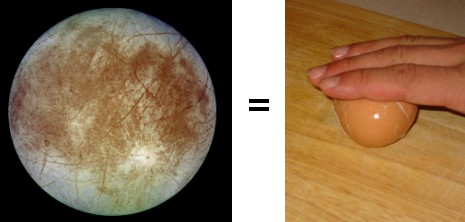
Tidal forces on a moon are similar to the crushing forces acting on an egg rolled on a table. In the case of Europa the end result is also similar.

Formation heat is just the left over energy you get when you let a few trillion gigatons of stuff fall together.  The formation heat of everything in the solar system was exhausted billions of years ago (except for Jupiter, which continues to slowly deflate and release heat.  Essentially it’s too fluffy).

Tidal forces only really apply to inner moons around gas giants.  The tidal forces have to be huge in order to melt the core just by “massaging” the moon in question.

The most important thing for a liquid core is a supply of radioactive material.  Given the amount of radioactive stuff left in the solar system today (it’s been draining away for the last 5 billion years) an object needs to have a mass between about 1 x 10²³ kg and 3 x 10²³ kg (between 0.02 and 0.05 Earths, or around 70 million “Deimoses”), give or take.

So age, size, tidal forces, and density are just some of the many variables that go into whether or not a core will be molten.  In fact, given enough time Earth’s core will eventually run out of nuclear fuel and solidify.  But don’t get too concerned, the Sun should swell up and swallow us long before then.

This entry was posted in -- By the Physicist, Physics. Bookmark the permalink.

12 Responses to Q: How big does an object have to be to gravitationally attract a Human or have a molten core?

  1. Carlos Palacios says:

    “given enough time Earth’s core will eventually run out of nuclear fuel and solidify”

    Are you implying that there is some sort of nuclear reaction keeping the center of the earth molten? Clearly, the earth does not have enough mass to power a nuclear fusion reaction due to the force of gravity. The earth would have to be closer to the mass of the sun in order for this to happen.

  2. The Physicist The Physicist says:

    You’re absolutely right! The nuclear reaction in the Earth’s core is a fission reaction, while the Sun is powered by a fusion reaction. The reaction in the Earth is the radioactive decay of heavier elements, primarily: Potassium 40, Uranium 238, 235, and Thorium 232.

  3. ripularora says:

    is formation heat, tidal forces, and radioactive decay are the reason behind gravity? and why every thing which has mass has gravity what is the reason behind this force of attraction? and how the energy for nuclear reaction can be provided by mass ?

  4. ripularora says:

    how formation heat is formed? is it conversion of mass into energy ?

  5. The Physicist The Physicist says:

    The heat of an object doesn’t have anything to do with how much gravity that object has. As for why matter creates gravity at all; who knows? We know the nature of the relationship between matter and gravity in detail, but we still don’t know why that relationship exists in the first place!

  6. aaron solomon says:

    does an object need to be a specific shape (like a sphere) in order to create a depression in time space i.e. attract smaller stuff, and if not than why isn’t (or are there) little beads of microscopic matter sticking to my body? and what of the other object on earth that are more dense than i am? maybe the earths gravity intervening? the relationship of gravity to an object must be proportional!? but can those same conditions exist while on earth or do i have to be in zero gravity to observe the phenom?

  7. The Physicist The Physicist says:

    Any shape works!
    If you were in space, you would slowly accumulate tiny beads of ice and rock. You’d have to be careful not to move much, or you’d knock everything away (the gravity of a person’s body isn’t very strong). And you’re right: we still exert a tiny, tiny gravitational pull here on Earth, but the Earth itself exerts so much more that our paltry pull is overwhelmed.

  8. aaron solomon says:

    :) exciting!

  9. aaron ssolomon says:

    if i get a superconductor and an electro-magnet put them together “just so” and maybe have some gyroscopic effect, can i create a 3D rc machine. what are the physics of it? can it be airborne if i spin a coil or core within a coil in one direction for up and reverse for down?

  10. The Physicist The Physicist says:

    Unfortunately, even with fancy physics you’re still bound by “for every action there’s an equal an opposite reaction”. Everything that flies needs to be held up by something. Either it’s lighter than air (blimp), or it pushes matter downward (helicopters, rockets).

  11. aaron ssolomon says:

    how does quantum trapping work? might this be useful to make something that can be engineered for airborne activity?

  12. The Physicist The Physicist says:

    There’s a (derivable) law from electromagnetism called “Lenz’s Law” that say that any change in the magnetic field through a conductor results in a current, that creates a new magnetic field, that opposes that change. Usually the “responding” field is substantially smaller than the original field because energy is lost to resistance. However, in superconductors resistance is not an issue, so the responding field is always exactly strong enough to resist the change (the magnetic field is “trapped”).
    Although, for smaller samples and fields, you can physically grab the super-conductor and move it (change the magnetic field through it).
    That said, even when one of these super-conductors is hovering over a magnet, it’s not weightless. It’s pressing down on the magnet.

Leave a Reply

Your email address will not be published. Required fields are marked *

You may use these HTML tags and attributes: <a href="" title=""> <abbr title=""> <acronym title=""> <b> <blockquote cite=""> <cite> <code> <del datetime=""> <em> <i> <q cite=""> <strike> <strong>