
Physicist: The original post is here.
The curvature of space alone has almost no effect on the movement of objects until they are moving really fast. With the exception of only the most extreme cases (black holes), space is very, very close to flat. For example, the total stretching of space due to the Earth amounts to less than 1cm. The precession of Mercury’s orbit is another example of the tiny effect of the curvature of space (and it is tiny). Literally, there’s a little more space near the Sun than there “should” be, and as a result the direction in which Mercury’s orbit is elliptical moves. It takes a little over 3 million years for it to go full circle.
In almost all cases the vast majority of an object’s movement is tied up in its forward movement through time. The curvature of spacetime (not just space) is responsible for gravity. Literally, near heavy objects, the “future direction” points slightly down. So anything that moves forward in time will find its trajectory pointing down slightly. This takes the form of downward acceleration. This acceleration (time pointing slightly down) is entirely responsible for the motion of the planets, and every other everyday experience of gravity.
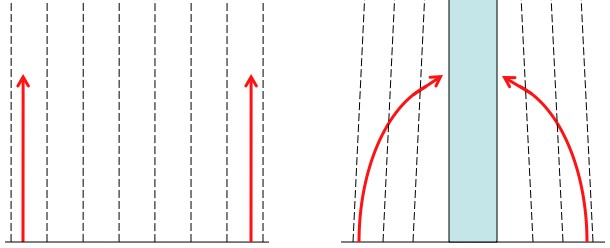
In flat space traveling forward in time has no effect on your movement through space. In curved space (e.g., near a large blue mass) parallel lines can come together, and moving through time leads to movement downward.
It may seem a little confusing that, once you’re moving, the explanation doesn’t change and falling is still caused by movement through time. Well, there is some effect caused by spacial movement and the spacial part of the curvature, but these effects are almost completely overwhelmed by the effects from the time component of the velocity (much, much bigger).



Nige/l is right. U really have to watch that YT video, to truly understand this.
Even though I find the guy’s voice a wee bit affected/irritating, at first, anyway.
Sorry, and I should have said LOUD! Once I cut it in half it’s OK.
If gravity decreases as inverse square, with radius/al/distance,
how would U describe how time dilates/decreases, with:
. Speed/velocity? It really is a circular function!?
. Gravity? Square root of (1 – inverse)?
Is there a more elegant way of saying that?
This looks, to me, like the (gravitational) curvature of (just) space.
Is there a simple formula for that?
And how about the escape velocity? Square root of inverse?
Clearly GTD and EV are closely related.
When I started this thread last year I was not asking “Why gravity causes bends in spacetime.” I was asking if gravity exists at all without spacetime and mass. My question was sparked by Hawkins and Mladenow’s claim in their Grand Design that gravity (or the laws of gravity) caused the universe’s existence. My question was informed by Einstein’s opinion that gravity is not a force, but simply the warping of spacetime by a mass, whereas H & M claim that gravity came before anything. This is deeply puzzling to me as a non-physicist.
Tony
Actually, I now think it was just I/me. Lack of sleep caused me to perceive everything as (too) loud. I can now listen to it on full volume, even in double time.
When U say the total stretching of space due to the Earth amounts to less than 1cm,
do U mean radially or vertically? Or is it the same, thing?
. In her “How does Mercury’s orbit prove GR” YT video Dr.Becky says that Einstein’s formula is the same as Newton’s except for the extra term 2GM/(c^2r^3).
But even for the Sun as a BH at the EH it is effectively 0!?
And Britannica says the stretching decreases as the fourth power.
That must be the (8PiG/c^4)*Tuv term. What do U say, to that?
Sorry, I had a senior moment, there:
I meant to add/say “But that’s 1/c^4 not 1/r^4, so what gives!”?
Maybe we should have an edit function, here,
so I could fix up the formatting in my previous post.
Well, this at least answers “Why does time dilate with speed?velocity?”
but I’m not so sure about gravity.
I suspect it may be putting the proverbial cart before the horse.
Surely space is physical and time is only/just virtual.
In a HW based universe anyway.
I can see how time may affect the speed of light, so that it remains c,
but I don’t see why matter should care.
Surely TIME is just The Internal/Intrinsic Motion of Everything.
Why don’t U guys put Ur heads together and show us
what a 4D spacetime continuum actually looks like, visually,
if U haven’t done so already.
I coulda/shoulda said:
If U drop a clock into a BH, whether it is mechanical, electric/al, electronic?al or
atomic, as it approached the EH it/s time would slow down, and at the EH
actually stop, coz time stops at the EH, which is what makes it the EH.
Now, some claim that its image would freeze there, while/st the clock continued,
towards the center. Surely, if the image stops, then so, must the object/clock!?
How can U have/see the image without the object?
Oh, some sort of Cheshire Cat, nonsense.
@TW: The short answer is NO.
As MGBB/My Good Buddy Bert said
“Gravity is just the curvature of the 4D spacetime continuum”, by matter/mass.
@TW:
If I wanted to give H&M the benefit of the doubt, I would say that they were saying that without gravity matter would not aggregate/clump/come together and the universe would be a soup of atoms/molecules, but there are other forces, like electrostatic/magnetic, and I don’t think that’s what they were saying. They were saying exactly what U said they did, to which I say:
. When people who aren’t that/very smart try to get too smart/clever, by half/ves, they outsmart themself/ves.
.A How’s that possible?
.B A fool will find a way.
.A Damn smart that fool.
.B See!?
.A Si, si.
. Seriously, now: JBWheeler said “Matter tells spacetime how to curve and curved spacetime tells matter how to move”. Matter has to come first. Without matter there is no gravity, and U don’t need gravity for matter to form, in the first place.
. A $M question, no fizzy cyst has asked let alone answered, is “HOW/WHY does matter tell spacetime how to curve”?
.A OK, fine, HOW/WHY?
.B I can’t tell U. Well, I could tell U but/t if I told U, I’d have to kill U… Or, marry U.
It’d be the only way to keep U quiet.
.A I choose death!
.B Then I won’t tell U, coz I don’t want to have to kill U.
.A Ah’. Then I’ll marry U.
.B Then I choose death!
.A Oh a wiseguy. Then I’ll kill U!
.B Ye’s. Then U will never know.
.A Ye’s.
@TW: “STARTED THIS THREAD, last year”!?
Are U sure U are in the right place/site, mite?
Current thinking is split between gravity having a quantum property and gravity simply being an effect in the way that mass warps space-time. Notwithstanding these ideas it could be that there is a quantum particle that contributes to the effect that matter is seen to always move towards the largest mass in its vicinity.
A most recent theory is that of ‘entropic gravity’. Entropy is fundamental to how the universe ‘works’, everything in the the universe will breakdown to its simplest state. This was something that was first noted by the mathematician Arthur Eddington. He proposed that entropy always increases, and that unless matter is acted upon by an external force, matter would naturally move towards disorder and is always moving to its simplest state, he used the term the ‘arrow of time’ to describe how this state is irreversible because time moves continually forward. It builds on the second law of thermodynamics, which states that all systems, including the universe as a whole, will spontaneously proceed toward thermodynamic equilibrium, which is the state in which Entropy is maximized. Entropy is a measure of “disorder”. Even at a sub-atomic level, an electron can spontaneously drop to a lower energy state which becomes a progression of that system toward thermodynamic equilibrium, this increases Entropy thereby decreasing the system’s ability to do work.
The Second Law of Thermodynamics is an Empirical Observation, it is a result of observing how the universe is structured. This means that it is not derived from the mathematics that underlies the other laws of Physics.
In General Relativity, mass causes a time-dilation, in that mass slows time compared to the surrounding space. Entropy is the outcome state of any number of particles in any proximity, If they are not subject to an external force that causes them to move away from one another, they will be attracted to each other to form mass. As mass increases so does the entropic state and the greater the time-dilation and as a result the stronger the attraction which is the effect we see as gravity. Due to entropy, matter will “gravitate” to where time is slowest. The curvature of “space-time” is more about time than space as matter is attracted to the slowest time differential.
@TW: Mite, It looks like the FC/Fizzy Cyst is too busy, to answer, U,
so I’ll ‘ave to, do, it, instead:
. I can’t remember if I read the book, and if I did, it was a decade ago
and I didn’t think much of it coz it was forgettable.
But I have read its WP entry and I got this line from there:
Because there is a law such as gravity, the universe can and will
create itself from nothing.
Spontaneous creation is the reason there is something rather than
nothing, why the universe exists, why we exist.
It is not necessary to invoke God to light the blue touch paper and set
the universe going.
I didn’t buy this, creatio/n ex nihilo, line, from them/THs/theists;
I am not going to buy it from fellow atheists, n/either.
Creation out of nothing my/pig’s arse/ass!
“The universe just sorta popped into existence, some 13.8 B years ago,
out of nothing and nowhere”. Really.
“No, it wasn’t nothing. It was the quantum vacuum”. PHR!
. I feel the same about Lorry Kraut’s A universe from nothing, book/let.
. I do actually know lots more but/t “800 characters is too small to
contain it”. Haa!? U’ll just have to wait, to see my
HW based model, of the universe, and my SW based model, of the cosmos.
. WP=WikiPeedia, TH=Thick’Ead, HW=HardWare, SW=SoftWare, B=Billion=10^9.
@Nige/l:
I beg to differ, mite, but I will not argue, with U,
coz I don’t want to give my TOE away.
But surely, when matter clumps together, due to gravity,
its entropy decreases!? Or stays the same?
Please enlighten me.
Where did the quantum vacuum come from?
@JS: Indeed. “I had no need of that hypothesis”.
@TW: I forgot to add/say “Nothing comes from nothing”. NOTHINK!
Just ‘avin’ a little laugh, mite.
@Nige/l: I am beginning to come around/to/think U/s may be right, after all.
I slept on it, and even without thinking about it, this morning I woke up and
thought “Where there’s smoke there’s fire” and I remembered that I proposed
something like this some farty-two years ago, as uni student, half seriously.
I was toying with a SW based model and I said “Matter clumps together
simply to decrease the workload, coz time runs slower inside it and so it has
to be updated less often, internally anyway”.
But then I figured out how matter curves space/time physically and I
developed a whole TOE around it, as U would, without even bothering
to learn much physics, as U would/n’t. Well, I didn’t have to. I was a
computer science student.
And I was happy with that until 2019, when I developed a SW based model,
to explain all the QM paradoxes/phenomena. I now have no doubt/s that
our cosmos is implemented in SW, for something like that is possible only
inside a computer, by a computer.
Do U guys realize the full implications of what U are saying?
How can something like that actually be implemented?
But/t more on this, later. I’LL BE BACK, vith a vengeance.
123456789 123456789 123456789 123456789 123456789 123456789 1 3 5 7 9 1 3 5 7 9
Just trying to see how many columns I can actually fit, in, exactly, really.
It looks like 79. Ve shall see:
123456789 123456789 123456789 123456789 123456789 1234567890 2 4 6 8 0 2 4 6 8 It depends upon the characters.
ABCDEFGHIJKLMNOPQRSTUVWXYZ abcdefghijklmnopqrstuvwxyz
abcdefghijklmnopqrstuvwxyz abcdefghijklmnopqrstuvwxyz abcdefghijklmnopqrstuvw
27+27+23=77 LCs.
ABCDEFGHIJKLMNOPQRSTUVWXYZ+ABCDEFGHIJKLMNOPQRSTUVWXYZ+AB
27+27+2 =56 UCs.
@TW & JS:
“The universe just sorta popped into existence, some 13.8 B years ago,
out of nothing and nowhere”. Really.
“No, it wasn’t nothing and nowhere.
It was the quantum vacuum and IMAGINARY TIME”.
Ye’s, I forgot about that.
I didn’t buy this, creatio/n ex nihilo, FAIRY TALE/STORY…
@Nige/l: No, U’re right. I just remembered:
As a BH swallows up matter/energy its EH grows,
as so does its “information”/entropy.
A single particle BH would have minimal info/entropy.
But isn’t a BH supposed to be a singularity, so what gives!?
If gravity is caused by time dilation, then why does g/ravity vary as inverse square, with distance, & GTD doesn’t, and even at the surface of the Earth GTD is practically 0, as is space curvature, supposed to be?
It’s not chicken or egg first ..
It’s chicken-egg Unity.
Humans have as much trouble with that as with concept of infinity.
Our brains can’t do physics without interpolating the poetic.
So physics is both mathematical and poetic – we simply cannot conceive or grasp or apprehend the universal without Both.
In General Relativity it is possible to use the Schwarzschild metric and apply it to a mass, (such as the earth), you get a simple metric using the terms for flat Minkowski space-time, this metric does not have gravity associated with it and has a time-only term that corresponds to gravitational time-dilation.
Minkowski geometry of special relativity is flat. This can be seen by the metric, which measures distances between a point and neighbouring points in spacetime. For the Minkowski metric we have ds^2 = −1⋅c^2dt^2 + 1⋅dx^2 + 1⋅dy^2 + 1⋅dz^2
Calculating the pathway of an object for this simplified metric, it gives you the same results for Newtonian gravity.
The Earth’s mass causes a time dilation field around the Earth, and the gradient of the time dilation field causes the paths of objects to bend in a way that looks like the 1 over R^2 formula that Newton formulated.
Thank U, Nige/l. I hear what U/re sayin’. It’s the gradient, of the TD field.
If this really is true, then I will have to abandon my HW based model, of the
universe, and really embrace my SW based model, of the cosmos.
Pity, coz I was really happy with it.
In it space is “real/material/physical” and time is just virtual.
But then again I have absolutely no doubt/s our world is implemented in SW.
If this is true, then how come the only physics professor I ever heard claim this
was Brainy Green/horn/e in his 2011 pop/ular physics book The Hidden Reality
in a strange/odd direct footnote on P14!?