
Physicist: Straight.
In fact, in mathematics the “curvature” of a curve is usually defined as the “reciprocal of the radius of the osculating circle”. This is fancy talk for: fit a circle into the curve as best you can, then measure the radius of that circle, and flip it over.
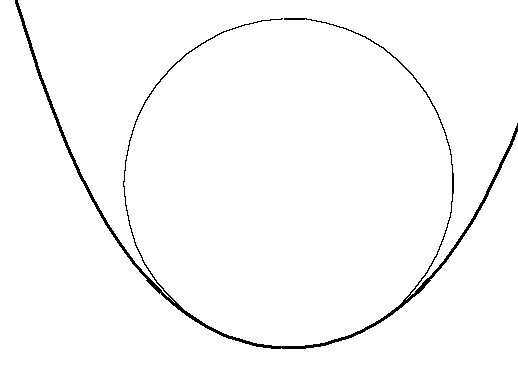
At any given point the osculating (or "kissing") circle is the circle that fits a curve as closely as possible.
It makes sense; a smaller circle should have a higher curvature (it’s turning faster) but it has a smaller radius, R. So, use 1/R, which is big when R is small, and small when R is big. There are some more technical reasons to use 1/R (like that you can apply it directly to calculating the centrifugal force on a point following that path, or that it gives rise to the entirely kick-ass Descartes’ theorem), but really it’s just one of the more reasonable definitions.
So, just working with the standard definition, you say: the curvature of a circle is 1/R, if I let the radius become infinite, the curvature must go to zero. Zero curvature means no bending of any kind. Must be a line.
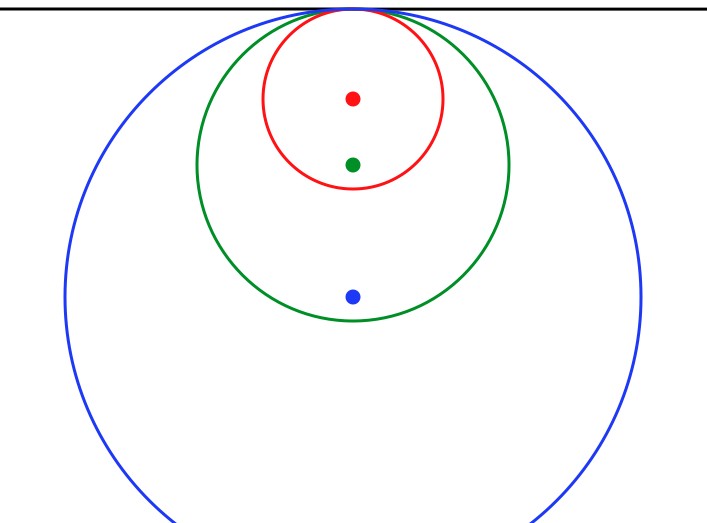
Nail down the edge of a circle. As the center gets farther and farther away, the radius gets larger, and the curvature gets smaller. When the "circle is centered at infinity" the curvature drops to zero, and the edge becomes a straight line (black).
Old school topologists get very excited about this stuff.
Say you have two lines on a plane. They’ll always intersect at exactly one point, unless they’re parallel in which case they’ll never intersect at all. But the Greek Geometers, back in the day, didn’t like that; they wanted a more universal theorem. So they included the “line at infinity” with their plane, and created the “projective plane”. In so doing they created a new space where every pair of straight lines intersect at one point, no matter what.
To picture this, imagine the ground under your feet as the plane and the horizon as the line-at-infinity.

The tracks are parallel, so they'll never meet. But, they look like they meet at the horizon. So why not (mathematically speaking) "include" the horizon and define that as the place where the tracks meet?
Parallel lines meet at two points on the horizon (in opposite directions). So the line at infinity is weirdly defined with opposite points on the horizon being the same point. Mathematicians would say “antipodal points are identified”. In the projective plane two lines always meet at one point.
Notice that east-west parallel lines meet at the east-west point on the line at infinity, and north-south parallel lines meet at the north-south point at infinity. So you do need the entire horizon, not just a single “far away point”. A single point would yield the Riemann sphere, which is also good times.
Back to the point. If you think about circles in this new-fangled projective plane, one of the first questions that comes to mind is “what happens if the circle includes a point on the line at infinity?”.
No matter how big the circle is, or where its center is, the whole thing will always be in the plane (not all the way out to the line at infinity). If the circle does have a point on the horizon, then you’ll find that the center also has to be at infinity (if it’s in the plane, then it’ll be closer to some points on the circle than others, but the center point is the same distance to every point on the circle). Specifically, the center will be on the line at infinity exactly 90° away from where the circle intersects the line.
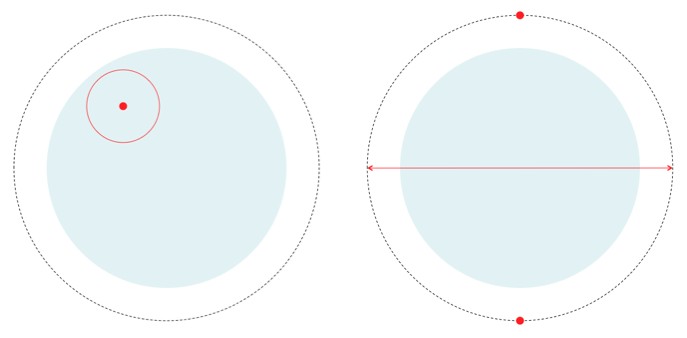
The projective plane, which includes the usual infinite plane (light blue) and the line at infinity (dashed line), and two examples of circles. Note that, although the plane is infinite, the line at infinity wraps around it in the same way that the horizon would still wrap around you even if the Earth were flat and infinite (this is an abstract picture). Left: a circle and its center in the in the ordinary plane. Right: a circle that passes through the east-west point on the line-at-infinity. Its center is at the north-south point on the line-at-infinity.
This agrees surprisingly well with the intuition behind the more colorful circle picture above. Science and math truly are a beautiful tapestry of interconnections and nerding right the hell out.



Pingback: Fourth Linkfest
I could be misunderstanding, but given the edge of a circle centered at infinity has zero curvature, so is straight, and that any straight line can be described this way too. What defines a circle as a circle? Do circle exist as separate and distinct from lines?
Would two circles centered at two different points at infinity intersect at only one point? or an infinite number of points?
The projective plane is one of a few different ways of looking at the situation (there’s no “correct” one). Having a center at infinity dictates the direction of the line, so two “circles” with different centers on the line at infinity would be two lines that cut across the plane at different angles. They’d intersect at one point (somewhere in the plane).
Circles and lines are different in the ordinary “Cartesian” plane, nearly the same in the projective plane, and exactly the same in the “compactified” plane (the Riemann sphere). It’s just a matter of picking your topological poison.
I prefer the projective plane because it’s easier to picture. Most mathematicians prefer the Riemann sphere (a point at infinity instead of a line) because it makes complex (as in “square root of -1”) mathematics easier. But, you know, whatever works.
Another perspective.
(Real) projective space is the quotient of the sphere by antipodal identification, so when you’re talking about a curve in the projective plane, you’re really talking about a curve on a sphere that is the same reflected through the origin. In particular, this is true of great circles. So great circles on the sphere become lines through the origin of the projective planes.
But the Greek Geometers, back in the day, didn’t like that; they wanted a more universal theorem. So they included the “line at infinity” with their plane, and created the “projective plane”. In so doing they created a new space where every pair of straight lines intersect at one point, no matter what.
The Greeks invented the projective plane? I thought the Greeks didn’t like infinity and that projective geometry came much later.
(It makes me sad to think that i’ll probably never see your reply, because I’ll probably forget to visit this page again in a few days. have you ever considered making it possible for commenters to receive future comments via email?)
Not intended to be a factual statement.
This is the sort of thing that follows on the heels of Euclid’s postulates. Somebody back then must have been pondering this stuff.
Basically, the notions of the projective plane (the horizon, lines and circles having a lot in common, …) goes way back. But no, you’re right, the Greeks definitely didn’t come up with the rigorous definition and formalism of the modern projective plane. That was just in the last couple centuries.
any question containing any reference to “infinity” is incoherent, and asking questions that actually mean something ought to be encouraged.
the entire line taken by “the Physicist” misses a critical point. infinity is not a number, and division by infinity, as an immediate consequence, is as internally consistent an idea as division by purple.
the limit of the sequence of curvatures may be zero, but you’ve some interesting work ahead of you, to show the sequence of curves on that diagram converges to anything, let alone that the curvature of the limit is the limit of the curvatures.
Infinity definitely isn’t a number, but in this context (trying not to get too pedantic) I approached it in terms of limits in the first half, and in terms of topological closure in the second. That is, redefining the space to include infinity (“numberizing” it). Both of those approaches are totally kosher. . Solving for y we find:
  . These solutions correspond to the upper and lower halfs of the circle. The lower half doesn’t converge, but the upper half does. Holding x fixed, and allowing R to become arbitrarily large:
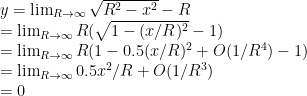
As for the circles approaching a line I figured a picture was best, since the strictly mathematical approach is a bit dry. That being said:
This set of circles, indexed by the parameter R, are defined as
So, at every point x along the line the y value of the circle converges to zero. The lower half doesn’t converge at all (unless you change the topology).
The short answer to this question is curved, that is, if the question made sense in the first place.
Consider any tangent line to a circle. It contacts the circle at precisely one point. For the edge of a circle to ever be straight, it would have to contact the tangent line at more than one point. Can this ever happen? No, and here is why:
Take any circle of radius R where R is a real number. Any line perpendicular to the radius will contact the edge of the circle once.
Double R, and the tangent line still only contacts the edge once.
Double R again, and we get the same result.
Repeat this again and again and again…We still get one contact point
We could define this as a function: The number of contact points of a tangent line to a circle as f(R)=1. The limit of this function as it approaches infinity is still going to be 1.
Absolutely!
Given that definition, the edge will always be curved. But it doesn’t seem like the most intuitive definition.
If a line start in 0 and rise to 1, 2, 3, and continue rising to infinite. After infinite, the line change direction and rise to infinite -1, -2, -3….. up to reach -infinite. Line continue rising from -infinite +1, +2, +3….. to reach 0. This create a circle with infinite radius.
Pingback: Q: If Earth was flat, would there be the horizon? If so, what would it look like? If the Earth was flat and had infinite area, would that change the answer? | Ask a Mathematician / Ask a Physicist
Gilbert Circle: Hey look ! My circumference is flat
Judge McFactory: Ok Mister, you are no longer allowed to call yourself a circle.
Gilbert: Noooooooooooooooooooooo !!!
Any definition, once put in an “infinity” or “infinite” or any similar meaning for that manner, tends to screw up our intuition.
When infinite radius comes in, circle = line. Hard to imagine, considering the fact that both shapes are fundamentally different in their topology (one is closed loop while another is open ended), sure at certain plane they tend to be similar but if we take the definition in a nutshell, it tends to violate common sense.
Considering two big identical circles with their radius overlap by say 1 meter apart, say now the circle is 10 meter radius big, or any arbitrary size as long as it’s more than 1 meter long, their circumference tends to meet each other at least 2 points. Now, as we extend the radius of the circle (inflate it) to say, infinity, while maintaining the overlapping of 1 meter, (the center point of both circle will move out further from each other) will the circumferences still cross each other? Or they become parallel line altogether? It seems the characteristics of the circle changes as the radius goes bigger, which is weird since a line is always a line no matter what the length is, if they are parallel when their length are 1 meter, they will still be at length = infinity. But not with circles, based on the above arguments.
BTW, how about sphere? what will they become if we inflate them to say, radius = infinity? will they become flat plane like a piece of paper? mind-boggling isn’t it?
In a circle / sphere with an infinite radius, there ceases to be a single point that we could refer to as the center of the circle / sphere. As such, every point within that circle / sphere “is” the center of that circle. With “r = infinity” and “circumference = infinity” the center blurs into infinity and as such the space within the circle / sphere attains holographic property so that every point within such a circle / sphere contains the “whole” and the “whole” is contained within every “point” – This is where mathematics and spirituality meet – within the singularity of the infinite universe
WOW Remarkable, What if we have instead of Riman Sphere with unity radius, Infinitie radius, the projection of ∞/0 would it be א one (of course assuming continuum hypothesis)?
Another Question which branch of mathematics that concern about representing infinite?
Sorry I know it’s but you may kindly answer these Q’s
Note: I have nothing to do with ahmad above!
Why are you trying to turn the circle into a square? Do you realize by ignoring the curvature of the infinitely large circle, you’re effectively turning it into a square? This means the vertices of this new square/circle will have a diagonal/radius sqrt(2) times longer than it should be… You’re distorting the circle. Even if the circle’s curvature seems to approach zero it is all relative and a matter of perspective.
For example: If one is near sea level he or she cannot really see that far (few miles?), but as one is elevated higher, then the horizon gets further away. The same applies to your problem here. Sure you can say that the curvature approaches zero as the radius approaches infinity, but that is from a small perspective. From an infinite or beyond infinite perspective, it begins to look like a circle again or eventually a point from further out.
This is why I never liked trying to fit circles into parabolas and measuring things like curvature. To me it makes so little sense and saying that a circle becomes a line at infinite radius makes less sense. One because we’re dealing with an infinity and secondly because it is like saying the Earth *is* flat instead of saying it *looks* flat but has a horizon which is a more accurate statement to make.
A circle of infinite radius is neither a circle nor a straight line.
Think about it. When was the last time you saw:
1. A Perfect Circle – You haven’t. Pi is Infinite.
2. A Perfectly Straight Line- You haven’t again. Again, while calculable, Pi is Infinite.
3. Randomness – An illusion we carry for things we cannot explain. We have random number generators, but this is not a random number.
Therefore, it is most likely that none of these concepts exist. More than likely, they can’t.
The Infinite Circle is the Fibonacci Sequence.
More thoughts:
We perceive that they do because of our brain’s visual system’s auto-complete’s concepts for us. (http://theamazingeye.wordpress.com/2008/04/07/visual-auto-completion/)
” The answers are between the numbers.” Between 0 and 1 there is infinity. Going by the description in the last post, The Infinite Circle is the Fibonacci Sequence. Thus, I propose that the universe is cyclical, infinite, and recurring. It’s the Infinite Story: the Greatest Story Ever Told. This is how you divide 1 by 0… because the answer is that neither exist and all divisions are illusory. You cannot be relative to everything around you without everything being one entity. One concept. One thing.
The Fibonacci sequence is everywhere because geometry (or, rather, scared geometry) is everywhere. The spiral IS infinity.
Further to Kelvin’s point that “circle = line” when contemplating infinite radius of a circle, Lao Tzu said in the very beginnings of his Tao Te Ching that (and I’m paraphrasing) concepts of beauty and ugliness arise together, front and back, long and short, good and not-good, foreground and background, etc… that you can’t have this (Yin) without that (Yang). In other words, try to imagine something being beautiful if you couldn’t simultaneously have the concept of ugliness in your mind… it’s not possible because they must go together, the two are actually one. The same would go for the concept of the open-ended line could not be perceived without the close-ended circle to contrast with it. You could say that open-line and closed-circle are both mental abstractions from the concept of shape. The cosmos is whole, the human mind is able to make Yin/Yang distinctions, but are you able to see that the distinctions are also not real. I think Buddhists use the term “void”.
The way I think of it is that the “oneness” or “wholeness” of the cosmos includes all parts of you including your mind and emotions, and you can’t step out of reality and perceive it from outside of reality. Much like the general delusion you sometimes find in science that you can conduct a controlled experiment completely removed from the environment, rather that the experiment is inextricable from the environment because ultimately there is no distinction in reality between “experiment” and “environment”. You can use words and numbers and statistics but you could also remember that they aren’t ultimately real. That ultimate certainty couldn’t eliminate the chaotic any more than light could eliminate dark, because there is no light without dark to contrast with it. As a scientist myself, that my science is no more important than the work of the artist, that they’re both necessary for harmony as the Taoists would put it.
I am not familiar with any academic axiom that exceeds Lau Tzu’s axiom (self-evident truth) of Yin/Yang. In the west we expect to find the ultimate answers to the universe, forgetting that you can’t produce an answer that doesn’t also produce a corresponding question. But you can peacefully continue on with your life and work if you remember that you split the whole into two in the first place. “Hold to the center” as Lao Tzu put it.
Curved. It may be close to a straight line, but will never be a straight line. 1/R will never be zero, no matter how much infinite is R. We need R=1/0 in order to have a straight line and 1/0 is not infinity.
Back to basics. A circle is defined as those points (in a plane) that lie at a given distance r from a central point C. Then, any point of the circle (A) must be at the same distance (r) from C as any other point B. This only makes sense if r is a number. We cannot say that A and B are at the same distance from C if r is infinite (that would allow us to say that infinite/infinite = 1). Then, “a circle of infinite radius” is meaningless.
I would think the solution would start with assigning infinity as zero degrees with an infinite radius and direction.
Then through triangulation determine the direction of infinity.
Such as the angular change in displacement of a photon through 360 degrees, from a given point of observation?
Angular vector sums?
You don’t need in invoke infinity to visualise these problems. A walk across the surface of the earth will do it. Or even better, imagine a Jupiter sized circle or larger; walking upon this sphere, from a human perspective, it would be very difficult to measure or detect a curve because the changes involved are infinitesimal.
What I lay at night thinking about though, is two of these large worlds at tangent, both are very flat, at human scale, yet impossibly; one “Curve” is trending up and other down!
I believe this thought experiment reveals problems with our intuitive mental models or perhaps even our fundamental geometric understandings. Is it such, that scale should be considered as a real dimension? Are there then, latent directions in simple 3D space (Those directly accessible to our senses).
Or even worse, are there missing aspects or limitations to our notions of dimensionality?
Perhaps straight lines might be the perfect definition of uncertainty!
To be clear, I’m talking about a static surface, superposition or phase cancellation shouldn’t be relevant!
But if scale is taken into account perhaps it might shed some light on the problem of extension vs position and other discontinuity mysteries.
I think that it is both. It is a straight line, except it somehow wraps around to the back of itself even though it’s a straight line. It’s hard to explain, Think of it as a 2-dimensional circle of infinite radius, think of that as a line which goes into the third dimension and loops back on itself. To the 2-dimensional perspective, the third-dimensional curved line is indeed an infinite length. For spheres, You do the same, Except you have it come out and loop back around through the fourth dimension. I also believe that the universe is a 4th or 3rd-dimensional sphere with infinite radius/diameter.
Pingback: on mountains and seclusion… | travel, travails and heck...