Physicist: Probably nothing. We do know that the universe doesn’t need anything to expand into, and we haven’t seen any evidence that there is anything outside of the universe. But there has still been some speculation.
In the last hundred years physics has gotten pretty weird, and defining “universe” has become a little tricky. So, in what follows I’m defining the universe as “all the places that could be connected to one another by a sufficiently long rope” (never mind how the rope got there).
Having never been outside of the universe, it’s hard to discuss it with any certainty. Most of the theories about the outside of the universe fall into the “I can’t say you’re wrong for sure” category.
We can say that space isn’t “made of anything”, and that it doesn’t need any kind of “higher space” to exist in. If space did need some other kind of space to live in, you find that the question just gets pushed back. After all, what’s outside of that space?
In a conversation about spacetime often as not you’ll have some unpleasant and unrepentant jackass drawing parallels to rubber or sheets or something else material. It’s not that these metaphors are misleading (although they are a little) it’s that they reinforce the quiet, underlying assumption that space is made of something, and that it needs somewhere to be. About the best definition of space is “Space is nothing more and nothing less than what rulers measure”. If you think about some of the properties of space, as described in relativity (both general and special), you find that it has all kinds of properties that a material can’t have.
For example, there’s no difference whatsoever between moving and being stationary. So, it’s impossible to meaningfully talk about “moving through space”, when you may as well be motionless. Even worse, you can fit an arbitrarily large amount of space within any volume (as measured from outside that volume). Think: Dr. Who’s TARDIS. Or, if that’s not your thing: the diameter of a circle drawn around the volume can be arbitrarily great, while the circumference stays finite.
Point is: space isn’t stuff. And the universe doesn’t need anything to expand into.
When you picture the universe as a whole it’s almost impossible not to think of a fish bowl or a bubble.
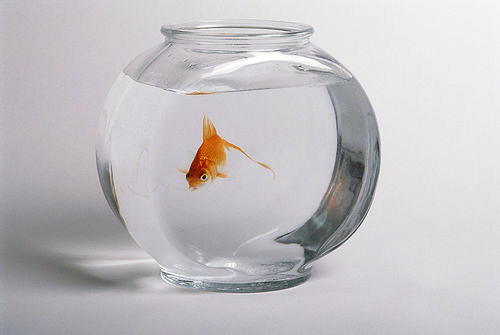
The Universe: Nothing like this.
Implicit in that picture of the universe is an outside. However, that outside is defined in terms of space, and all of space should be inside the universe. When you try to talk about the outside of the universe you find yourself asking questions like “okay, where are you?” or “how far from the universe are you?”, you know, the types of questions that really rely on some notion of position and space.
That all being said, there are some theories that do talk about things outside of the universe. There are some proponents of M-theory who claim that the universe could be a sheet floating in a higher dimensional space, and that there are other universe-sheets floating along side us, just a tiny distance away. Although the other sheets act exactly like what almost everybody would call “other universes”, it’s would be slightly more accurate to say that the collection of sheets and the higher space they float around in are all part of the same “super-universe”. They’re still at least a little connected to each other.
Aside: Btw, when physicists want to talk about more than three dimensions they (being born and bred here) like to knock off dimensions to help picture things. So, if you want to imagine the universe in a higher dimensional space, just get rid of a dimension. The universe goes from a 3-D volume to a 2-D “sheet”.
The universe may also have “bubbled off” of some other larger universe, or spontaneously started, or who knows. If there are truly other universes, or any other stuff outside of our universe, it’ll be “causally separated” from everything going on here (or that has or ever will go on here). Rather than thinking of other universes as being “somewhere else” it’s better to think of them as “in every way independent”. You can’t even sensibly talk about “going there”.
Science (and more generally: everything we can know), being based on observation, inference, and experience, can’t say much about things entirely outside of the universe. We can infer, and make some spectacular guesses, but that’s about all. In another 20 years or so our entire approach to the nature of the universe will have completely changed (it always seems too).



We human beings are just like ants and ants can not know the milkyway…
Having read the above, I can now see why astrophysicists are having problems with dark matter. Space is made of nothing? Why can you not have a perfect vacuum.
Thank you Mister Physicist,
Very thought proving…
They talk of of something in the Universe called Dark Matter or Anti Gravity Stuff 🙂
But may be there are FORCES OUTSIDE OF OUR UNIVERSE that are acting
on every thing in our Universe, we just can not measure it, YET !
Luke
Space like time expands into nothing.
Yesterday is history tomorrow just a concept.
Science is now becoming a belief. the space dimensions you observe cannot be changed such as expand or contract it for it is not matter. the term expansion is relative to something else e.g matter expands in space. into what is space expanding? is space contained in something else?
cosmologists and theoretical physicists formulate their theories based on observations and or abstract using terms which are in contradiction even with common sensation. do not take realism for theories or abstractions. space is x y z cant expand.
Yes, we are definitely ants, but something little bit more superior or sometime less(inferior) that we can understand each other and comments over anything like the ants a tiny creature and about a giant universe because everything within our approach, understanding and power to thing and right to write. We are sometime superior because we can understand the universe, nature’s nature and either we can follow the order or may create chaos, everything is in our approach in our minds but they can’t ..They can do one thing that human can’t do anyway , what this nature exhibit them they follow and they are in a state of order ,perhaps they know the admirable order , perfection of this nature which we human will never know. I have more than that but i can not express my views mere in words but in my feelings.
thank you all.
other
I think that the universe is infinite, so there is nothing outside it.
Was the older universe similar to ours? I wonder sometimes.
Who am I?
Why am I here?
I have trouble understanding it when you say “nothing” is beyond our ‘real’ universe (not just the observable one). “Nothing” to me means empty space with nothing in it, not a material thing called “nothing” that establishes a boundary or edge to our universe. To my mind, our universe could expand into empty space (assuming that our universe is expanding and not merely fluctuating over a long period of time) but would not do so if the “nothing” were some kind of a limiting, but ultimately yielding ‘element’ that recedes as our universe expands. Besides, we may be one of many universes that are essentially infinite in number that extend forever. Who knows? Nobody. We cannot know what is beyond the universe or if there is a “beyond” to our universe. If it were possible to know, we may find that the universe is not only infinite, but has always existed. Throwing in the handy currently populat term spacetime is a crutch, in my opinion. I think the concept of Time is a construct of man over a very short period as a means of measurement and does not exist except for our convenience. I do not accept the currently popular idea or theory of the “Big Bang” as the start of the universe which can be backtracked 13.7 billion “years” to a point in “space” or in “nothing” that spontaneously and without explanation, exploded into a mass of particles that cooled for a few million years to form hydrogen atoms that segued into stars and later themselves individually exploded into supernovae thereby forming the heavier elements. There is no explanation for what constituted the “point” that exploded or what was the motive force was to activate it. I am NOT a creationist either. Both concepts are unbelievable to me. I am content to say that we humans do not and cannot know if and how the universe came to be and how it will change or end while our specie exists. It is beyond our intellectual ability to understand how and why we are here, what we may morph into and how we will disappear when we have run our course. I do believe that man and all currently know species will ultimately vanish (as so many other species have) and that we may or may not be succeeded by some other form of life or intelligence but I don’t think that is more likely than not. That does not scare me at my age as I have already live probably 90% of my allowable years. I will remain curious about all of the above until the moment that I breathe my last.
If there are black holes is space like swiss cheese or is it like a sieve?
Ahh, the term “black hole” is misleading. Think of one as a very dense lump of matter. Thus it has immense gravity that really sucks. Nothing goes through. Eventually all matter will be sucked into black holes, and eventually all black holes will be sucked into a single remaining hole. All that will be left is space.
There is not enough space left to write my reply.