Q: Why does the Earth orbit the Sun?

The original question was: What exactly causes the Earth’s rotation and revolution?  Does this occur due to centripetal force and the lack of friction to stop the Earth from spinning? IE- Newton’s First Law? If so, where did this centripetal force come from? Was it a product of this rock being hurled through space and stuck in the Sun’s pull? As for the rotation, I don’t even have a guess. Are there planets that don’t revolve at all, or is that a necessity?


Physicist: I’ll break this down into two questions: “Where does the rotation originally come from?” and “Once the a planet is in orbit, what keeps it there?”

Where does the rotation originally come from?: The original yearly rotation of the Earth around the Sun (orbital rotation), as well the daily rotation of the Earth about it’s own axis (just “rotation”) is essentially dumb luck.

If you hold out any object and toss it in the air, you’ll find that it’s almost impossible to toss it in such a way that it doesn’t turn at all.  The same is true of stellar nebulae (the gigantic clouds of gas and dust that condense to form stars and planets).  They always have at least a little bit of swirl and spin.

As the cloud that became our solar system collapsed inward, the mass settled into a spinning disc with a big bump in the middle (the Sun), and that disk began collapsing even more to form the planets.  This process is called accretion, and you can see it at work over and over again.
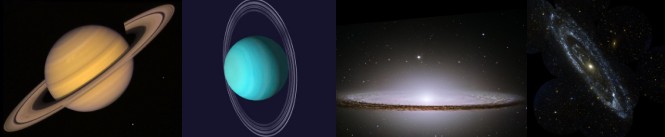
When stuff collapses it tends to form a central ball and a disk.

There aren’t any non-spinning planets, but the speed that they spin varies widely.  Jupiter’s day is only 10 hours long, while Venus’ is around 240 Earth days long.  How fast and in exactly what direction a planet will end up spinning is a fiendishly complicated problem.  Some of it is determined by the flow of the gas and dust of the “proto-planetary disk” (which is fairly simple), which is why the orbits and rotations of every planet in the solar system orbits and rotates in roughly the same direction.
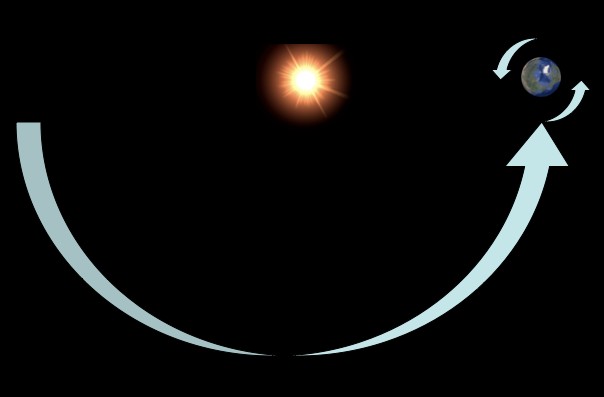
Since the Earth orbits the sun in the same direction that it rotates, when it's morning (6 am) you're standing on the "front side" of the Earth.

But once the ball gets rolling (so to speak) you find yourself with a solar system full of big rocks on slightly different orbits slamming into each other, and changing each others rotations.  For example, the Earth’s moon was (most likely) created by a stupendous collision with something Mars-sized that “splashed” the moon into orbit.  That impact, as well as tidal effects from the moon itself, have radically changed the length of the day on Earth.  Uranus is also believed to be the victim of an even bigger collision that tilted it’s rotation axis around 98° from it’s orbital axis (the direction perpendicular to its orbit), and dramatically changed the length of it’s day.  We can’t say by how much; no one saw what it was like before.

So, in general, things spin because they collapse from very large clouds of stuff that were spinning (just a little) already.  If the cloud hadn’t been spinning, then all of the mass in the solar system would have fallen all the way into the Sun.  Instead, a mere 99.86% of the solar system’s mass is in the Sun.


Once a planet is in orbit, what keeps it there?: Gravity pulls the Earth in, and centrifugal force holds it out.*  The centrifugal force on the Earth is just a result of the Earth moving in a curved path around the Sun.  It doesn’t slow down because there isn’t any friction.  After all, in space, there’s nothing to have friction with.  Why exactly an orbit is stable involves a short romp in math town.

Gravitational force, Fg, is given by F_g = -\frac{GMm}{R^2}, where G is the gravitational constant (dictates how strong gravity is), M is the star’s mass, m is the planet’s mass, and R is the distance between the planet and star.  It’s negative because it’s trying to decrease R.  You can use this to find the gravitational potential, Ug, by taking the anti-derivative: U_g = -\frac{GMm}{R}Force is the negative of the derivative of potential, which is fancy-speak for “stuff wants to fall downhill”.

Centrifugal force, Fc, is given by F_c = \frac{mv^2}{R}, where m and R are the same and v is the “tangential velocity” (how fast the planet is moving around the star, and not counting motion toward or away from the star).  There’s a handy way to rewrite this in terms of angular momentum.  Angular momentum, L, is always constant and (in this case) is given by L=mRv.  Re-writing Fc in terms of L gives: F_c=\frac{m}{R}v^2=\frac{m}{R}\left(\frac{L}{mR}\right)^2=\frac{L^2}{mR^3}.  You can use this to find the “centrifugal effective potential”, Uc.  “Effective” is just a physicist’s way of saying “I know, I know; the centrifugal force isn’t a ‘real’ force.  Just be cool for, like, two minutes.”.  U_c=\frac{2L^2}{mR^2}

Looking at the total potential, U=Ug+Uc, it becomes clear why orbits can be stable.  In order to picture forces better physicists will sometimes draw “potential diagrams”.  A potential diagram is just an intuitive way of describing energy and, in turn, forces.  To understand it, imagine putting a marble on the line and think about how it will roll.  In the picture below the marble will roll to the left, but no too far.
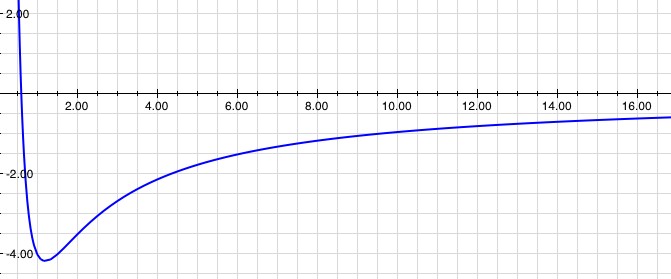
The total potential curve in terms of distance to the Sun. When a planet gets too close to the Sun the centrifugal force "rolls it away", and when it gets too far away the gravitational force "rolls it back". A stable or "bound" orbit is one without enough energy to roll out of the pit. This diagram helps explain why it's so hard to fall into orbit around something: If you start from far away, you have enough energy to get back there.

An orbit is stable when the energy of a planet is “cupped” by the total potential.  If it gets too far out the gravity pulls it back, and if it gets too close the centrifugal force pushes it back out.

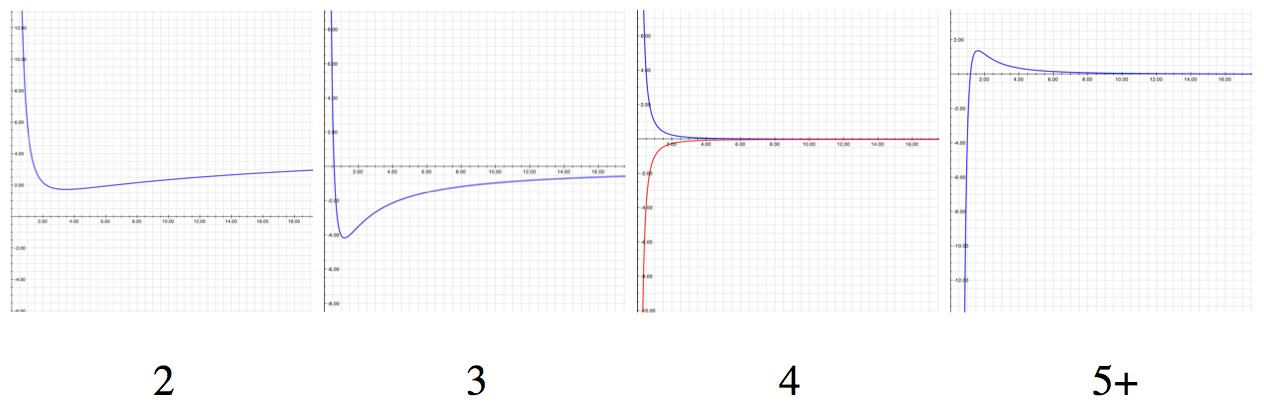
Also, as if you needed another reason to be excited about living in this universe, orbits are only stable in two and three dimensions.  The force of gravity drops in the same way that the intensity of light or sound drops off (in our case: 1/R2), so if the dimension of your space is D, then the force of gravity is F_g = -\frac{GMm}{R^{D-1}}.  This yields a gravitational potential of  U_g = -\frac{GMm}{(D-2)R^{D-2}} when D≥3, and U_g=GMm\ln{(R)} when D=2.

Gravity gets weaker, faster, the higher the dimension. In 1 dimension there's no circular movement and no orbits. In 2 and 3 dimensions the forces balance such that there are stable orbits. In 4 dimensions an object will either fall directly in or fly away forever (depending on its angular momentum). And in 5 or more dimensions gravity wins if an object is too close and centrifugal force wins if it's too far.

For small dimensions (2 and 3) the centrifugal force is stronger for small R and gravity is stronger for large R, which yields stable orbits.  For large dimensions (5 and up) gravity is stronger for small R and centrifugal force is stronger for large R, so the orbit is always trying to fly apart, one way or another.  In 4 dimensions the forces get stronger and weaker at the same rate (~1/R3), so if one is stronger than the other it’s always stronger.


*This isn’t technically true.  Technically the planet is moving in a straight line through curved spacetime, and experiences no centrifugal acceleration.  But whatevs.

This entry was posted in -- By the Physicist, Astronomy, Equations, Physics. Bookmark the permalink.

32 Responses to Q: Why does the Earth orbit the Sun?

  1. Neal says:

    Is centrifugal force real? http://xkcd.com/123/

  2. The Physicist The Physicist says:

    Real enough.
    It depends on your perspective. In a non-rotating frame you’d describe the “force” as the object being accelerated around a curved path (any path that isn’t a straight line with constant speed requires acceleration). When you’re the object doing the spinning, however, it’s hard to keep that in mind.

  3. Right, and so the next question is, “What is the best way to explain this situation?” It does indeed depend on perspective, and if we adopt the perspective of an observer outside the earth (let’s say looking “down” on the solar system, for example), then there is an argument to be made that it is preferable to avoid discussing centrifugal forces. (They are perhaps more useful when adopting the perspective of an observer on earth.)

    From the perspective of an “outside” observer, an alternative explanation is along these lines: If there were no acceleration, the earth would just carry on in a straight line at a constant speed (by Newton’s first law of motion). But the earth moves in (approximately) a circle. Why? There must be a reason … and the reason is that the sun exerts a force on it. OK, but the force had better be just the right size to account for the acceleration, according to Newton’s second law of motion, F = ma. Because the earth goes in a circle (approximately), a = \dfrac{v^2}{R}. (This is the centripetal acceleration.) Thus

    \dfrac{GMm}{R^2} = m \dfrac{v^2}{R}

    From this perspective, nothing keeps the earth out, and nothing is needed to keep the earth out. There is no balance of forces, one inwards and one outwards. The earth goes in the circle, therefore there must be a force acting on it towards the centre of the circle, and that is the only force needed for the explanation. The sun provides the force.

    For my preference, this is a simpler explanation, especially for a beginner. But the author’s explanation is also good; to each his own.

  4. Jeroen Versteeg says:

    What I’m really missing here in the answer to the first question is conservation of angular momentum, and how it makes the inner planets orbit the sun faster than the outer ones!

  5. The Physicist The Physicist says:

    A single planet must always have the same angular momentum, but different planets are free to have different angular momenta. So, angular momentum isn’t the best way to explain why different planets in different orbits have different speeds.
    The last equation in Santo D’Agostino’s comment (two comments up) is probably a better approach. If you multiply both sides by R2 and divide by m you get GM = Rv^2. “GM” (the gravitational constant and the mass of the Sun) aren’t going to change. So if R gets small, v has to get bigger to compensate. That is; if you orbit closer to the Sun, you have to orbit faster.
    If you don’t trust the math: the Sun pulls more when you’re close, so you have to spin faster to stay away.

  6. Ali Baaqail says:

    Why does earth is orbiting around the sun and spinning on its axis?
    There are thousands of thousands answers but none will statisfy you if you use your common sense.
    OK the law of gravity is playing a big role in this rotating and spinning. But where does this gravity come from? Who ordered or set it there so precisely. If speed of spinning rate faster than whatever is now….. say 2000 km per hour….. then we have two dawns and two dusks in 24 hours instead of ALMOST equal period of day and night.
    As one physcist answered “Is essentially dumb luck ” Is this you call sciense?

  7. The Physicist The Physicist says:

    Absolutely!
    Science does try to explain as much as possible about the universe around us, but part of that is knowing why there are some things that can’t be known. For example; using mighty science we can predict weather, with fair accuracy, several days in advance. But (again, with science) we also know why we can’t do much better (see: “chaos theory”).
    In this case we know that planets can form with a wide range of rotation speeds, because we’ve got 8 planets (9 if you were born in the ’90s or earlier) to take data from. The lengths of their days are all over the place.

  8. Ali Baaqail says:

    I am a person with no education but I read much and try to understand things. I deeply respect learned and people of knowledge and understanding, like you. Through such people human race had achieved a lot of comfort and left behind most suffering and misery. My argument is not leading to persuade you towards any faith or belief. Planets can form with a wide range of rotation speeds. But why our planet earth is so unique? Suitable for life! Why there is a tilt of 23 degree? So we can have seasons! Why the atmosphere with 78% and 21% of nitrogen and oxygen? Why with seventy percent liquid water? Why the full sky become dark at night and bright at day? From where the first life or first cell come from? Science cannot answer all these questions and a lot many. They can speculate. Based on your argument that the planet formed through gravity’s rotation of dust and gas. They are still trying, in Cern, Switzerland, since 1992 a project named (Large Hadron Collider), to create the basic particles of the earlier universe, after Big Bang. The result was very embrassing for science community. Also more than ten Billion $ bill to be paid. Common sense and reason tell us to accept all these happening are the result of Divine Intervention. The One God! Yours and mine.

  9. Pingback: On The Nature Of Scientific Theories | QED Insight

  10. Ali Baaqail says:

    Hi,

    Why full sky is dark at night and the same time other side of the globe (which facing the sun) is full bright? Please do not explain to me through Olber’s night sky Paradox.

  11. willard owen says:

    what is the variable in the earth orbit ellipse

  12. The Physicist The Physicist says:

    What do you mean?

  13. bob says:

    why doplanets have names?

  14. The Physicist The Physicist says:

    That’s kinda profound!

  15. cody says:

    I was a bit worried until I read the asterisk note on the end. Orbits are largely misunderstood so you have to be careful when explaining them. The only 2 forces that go into an orbit are the angular momentum of the body and the gravitational force pulling inward. There is no actual “centrifugal or centripetal force” that acts upon orbits. They are merely fictitious forces.

  16. szefunio says:

    Stable orbits exists as long as attraction strength between object falls slower than 1/r^3. In 4D universe gravitational attraction strength is 1/r^3, the lowest value generating no stable orbits [for example if atraction strength were 1/r^2.99999999 stable orbits would have still existed]
    We can quite easely have stable orbits in 4D universe if we make attraction between object to fall minimally slower than 1/r^3. For example: if in such a universe except for gravitation existed general repealing force whose strength falls faster than 1/r^3 (which is natural if force is mediated by bosons with non-zero rest mass) then nett attraction strength between object would fall slower than 1/r^3 and stable orbits would exist.

    Am I right?

  17. Joe Rit says:

    How can planets, stars, comets, and all objects in the universe be within the net of space/time without any friction acting upon them? If there is no friction from space/time then how can it support anything??

  18. The Physicist The Physicist says:

    It’s a little counter intuitive, but spacetime isn’t made of anything. Physicists define space as distance. The “fabric of spacetime” and “rubber sheet” ideas are just metaphors to help explain things.

  19. Craig Alan Owens says:

    Your claim that planetary orbit and revolution results from “dumb luck” is both false and professionally irresponsible. You may not know, but science DOES provide the answer. Maybe you should apply the scientific method and do more research into the actual question: “Why does Earth orbit the Sun?”

    The essential question here is WHAT FORCE PROPELS THE EARTH IN REVOLUTION around the Sun.

    You go off on tangents about centrifugal force and gravity, neither of which propels our Earth mass of 13,000,000,000,000,000,000,000 pounds at 67,000 mph around the Sun, and I’ll prove to you why gravity is not responsible for orbiting bodies.

    Our SUN, however, does possess enough energy, in the form of thermal energy and electromagnetism , to propel our Earth at a velocity of 67,000 mph.

    The Sun’s incendiary heat drives fusion and plasma production of an intense electromagnetic field spinning our Sun (like all stars) on its invisible polar axis.

    The Sun’s conversion of heat energy into electrical energy is similar to your car’s combustion engine that converts combustion (heat) into mechanical energy to spin the wheels that make your car move.
    But the Sun’s conversion of heat energy into plasma electrical energy occurs on a stellar scale, trillions of times more powerful than even the power of a lightning bolt (plasma) that can split a tree in half. Imagine the power of trillions of lightning bolts in our Sun spinning in a solar-scale electromagnetic field.

    Build or buy a simple Faraday disc and you’ll discover that spinning a magnet in its electromagnetic field generates voltage or electrical output. That EM field has an observable effect on particles around it, and when extrapolated to the Sun’s scale it has a propulsion effect on massive objects like our Earth.
    Faraday Disc (homopolar generator)
    http://en.wikipedia.org/wiki/Homopolar_generator

    Our Earth also produces its own EM field that causes Earth to spin, so it’s not “dumb luck” as you say, that it’s spinning. The Earth’s electromagnetic field causes its rotation and the Moon’s revolution in orbit around it. Just like the supermassive neutron star at the center of our Milky Way galaxy generating a super intense electromagnetic field that spins it and all the stars in galactic spiral arms around the neutron star; so too, our own star, the Sun, generates a powerful electromagnetic field that spins it around, and spins all the planets around it including Earth.

    So that’s it in a nutshell – the Sun’s electromagnetic field propels the Earth around it, just like our Earth’s EM field propels the moon in orbit, and our Galactic Neutron Star propels all the stars in our galaxy around it. Occam’s razor attests to the elegant correct answer, despite all the erroneous mathematical complexities used to skirt the issue of WHAT FORCE propels celestial objects in orbit.

    A simple proof that gravity is not responsible for stable orbits:
    Our moon is certainly massive, yet it cannot propel objects in stable orbit around itself. Why is that?
    That’s because gravitational pull is not a force that propels orbiting satellites. The moon is not thermally active and does not generate an electromagnetic field to propel objects around it in stable orbit.

    C. A. Owens

  20. Edwin Saji says:

    I’m only 14 years old and here’s my question.How did newton calculate the orbit of planets without the knowledge of the value of the propulsion or did he know?If he did how?

  21. The Physicist The Physicist says:

    Like any good physicist, Newton did exactly the opposite; he took the data that had already been collected about the shape and (comparative) size of the orbits, and then found that an inverse square force would describe how fast the planets were orbiting.
    A little later Newton showed that, given his inverse square law, the orbits must be elliptical (it’s not obvious why) which people had already begun to strongly suspect to be the case (again, from direct observation).

  22. argus says:

    THANKS FOR THE ANSWERS I FEEL SO FULFILED

  23. alex says:

    Physicist, would you please reply to Craig Alan Owens’ post ?

  24. The Physicist The Physicist says:

    I figured I’d stay quiet about that comment.
    It is the case that the Earth and the Sun (and a few other planets) have magnetic fields. However, it has nothing to do with orbits or the movement of planets. More importantly, since there’s nothing around to stop things in space from moving, there doesn’t need to be an extra force to propel them.
    Those were clever ideas! But they’re not supported by physics.

  25. Matt says:

    What is the closest distance that two Earth sized planets could be to one another without being pulled out of their respective orbits around a star? Just curious.

  26. The Physicist The Physicist says:

    Depends on exactly how they’re moving. For example, if they were in orbit around each other (like being moons of each other), then there are no problems.

  27. Matt says:

    I was thinking more along the lines of not being in orbit around each other.

  28. Matt says:

    That’s two seperate orbits around the sun. What distance would they need to be from each other to maintain steady orbits unaffected by each other, assumuing that one is the Earth in it’s current orbit speed and distance from the sun.

  29. The Physicist The Physicist says:

    Unfortunately that’s a pretty difficult question to actually answer.
    If you want to talk about “stable forever”, then the Earth’s interaction with the other planets is already unstable. “Stable for a while” is also pretty difficult. Given that Venus is about Earth sized and seems pretty happy where it is, I’d say that another Earth would do alright as close as Venus or closer.

  30. Elizabeth says:

    Okay, I have an idea. I’m only twelve and I like this stuff, so.

    Imagine right now, you on Earth. You are held down and at the same time as being pulled out. The sun overall has more gravity than Earth, but do to distance Earth’ s gravity manages to keep us here. Now set your imagination to work. You’re here on Earth with a stronger force pushing you down than being pulled out, then a microsecond, maybe even less, (nanosecond?) you’re on the sun (as if on an Earth with mass of one solar mass). Gravity, the pushing and pulling that weren’t equal, are now almost distorted and extreme things happen to relevance of time. Sorry, I’m bringing black holes into subject now. A supermassive black hole supposedly has you ‘go through time’ like a day being shorter or longer. The event horizon from a distance makes things look like they’ve stopped. But really, multiple things happen in different black holes theoretically.
    I’m thinking the two forces exerting gravity can’t be equal. (I’m still seeing if this can go with whole graviton and anti-graviton thing) Basically, the difference in either one is the difference to of you seeing something move in a different area of where gravity is exerted. How do I make my mind clearer…
    Um, okay think this. That ‘push and pull’ each go with graviton or antigraviton. The bigger the difference of this ‘push and pull’ than the more extreme changes of how time is exerted, seen, felt, experienced.
    So this would mean other things about orbits. I can’t do the math yet, but I’m teaching myself it so far. I know this is most likely false but good idea-like stuff, but I want to know if I’m on the right track.

  31. Matt says:

    Elizabeth,

    What is your question?

  32. Elizabeth says:

    Oh, sorry.. forgot to ask–

    The curving through space time I hear about all over internet, how does that fit in with Earth’ s orbit? And what does it even mean??

Leave a Reply

Your email address will not be published. Required fields are marked *

You may use these HTML tags and attributes: <a href="" title=""> <abbr title=""> <acronym title=""> <b> <blockquote cite=""> <cite> <code> <del datetime=""> <em> <i> <q cite=""> <strike> <strong>