
Physicist: In terms of feasibility: no. In terms of being remotely possible: yes, but probably not permanently.
Mars is much colder than Earth, has no water, and effectively no air. On the up side, unlike many planets, you can stand on Mars (it’s solid), and its day is nearly the same as Earth’s (24 hours, 40 minutes). Despite the bad news that follows, Mars is the best candidate for terraforming (making more Earth-like).
First problem: Mars is cold. The most searing heat wave on Mars would barely melt water. Unfortunately, this is a problem with Mars’ distance from the Sun. The only way to get Mars warm would be to create an intense greenhouse effect by mixing up the right atmosphere.

The size of the Sun as seen from Earth (left) compared to the size of the Sun as seen from Mars (right). There's not much sunlight, and not much that can be done about it.
So we need to add an atmosphere, which is pretty hard to come by. Mars has a little under 1% of the atmosphere we enjoy on Earth, so we’d be practically starting from scratch.
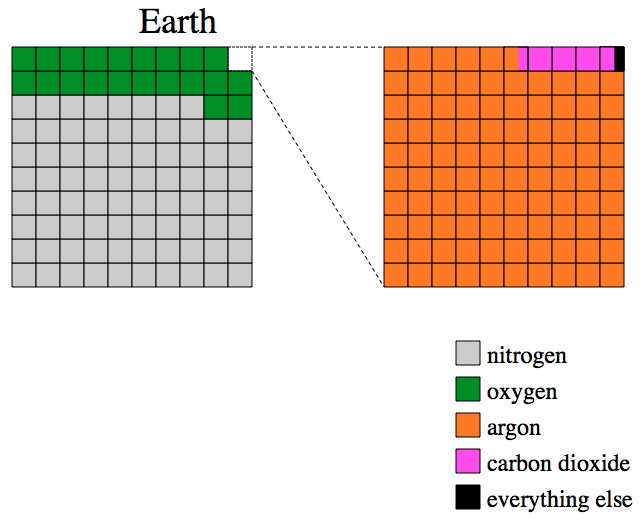
Our atmosphere is 99% nitrogen and oxygen. The last 1% is almost all argon. Carbon dioxide makes up a paltry 0.04% of our air. Moral is: we have a big, complicated atmosphere.
Mars did, at one time, have an atmosphere. The best theory today is that when Mars lost its magnetic field the Solar wind, that would otherwise be deflected, was free to gradually strip away Mars’ air. Mars also has about 1/3 of Earth’s gravity, making the process substantially easier.
So there’s some possibility that even if we did manage to establish a dense, warm atmosphere that it would suffer the same fate as the first atmosphere (after several thousand years). Every couple of millennia it may be necessary to touch-up the atmosphere.
The amount of green house gasses you’d need to keep the surface water liquid is very likely to be toxic. It’s been shown that human beings can survive CO2 concentrations as high as 4% (the research so far hasn’t killed anybody, but it has made some people sick). Unfortunately, concentrations higher than 4% are likely to be necessary to maintain a liquid water environment, and even 1% isn’t particularly healthy.
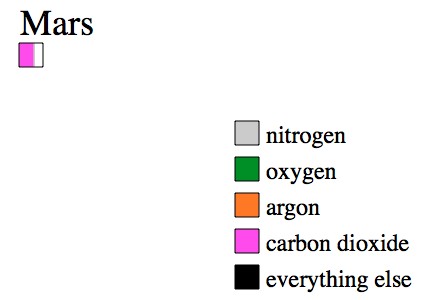
The atmosphere of Mars at the same scale as the picture above. If you were to stand on Mars without a space suit you would get a spectacular full-body hickey. In fact, the low (almost zero) pressure is probably the first thing that would kill you, so wear a space suit if you're going to Mars.
Other gases can be substituted for CO2 to create a green house effect. But most have other problems: too much methane could make the atmosphere explosive, and nitrous oxide tends to make people… weird. The best candidate is probably sulfur-hexafluoride (SF6), which is more than 20,000 times more effective than CO2 as a greenhouse gas, and is non-toxic. There are, however, more subtle drawbacks to SF6 and it would be pretty difficult to synthesize enough.
As the Sun gets brighter, we should find that in a couple billion years Mars will be in the “goldilocks zone” (and Earth won’t) and that whole “toxic concentrations of green house gas” problem becomes moot. It’ll be naturally warm enough in Mars’ orbit for liquid water.
It would also be nice to have oceans on Mars. Oceans are really good at circulating heat, “smoothing out” temperature fluctuations, and generally give rise to climatological niceness. Our oceans can store and release just a hell of a lot more heat than our atmosphere. In order to create oceans on 2/3 of Mars’ surface with a depth of 3 to 4 km (like our oceans) would require about 350 million cubic km of water. Luckily, we’ve got big blobs of water (or ice at least) flying around the solar system in the form of comets. But to top off Mars’ oceans would take somewhere around 3 to 4 million comets. To date there are only around 6,000 known comets, but there are likely to be billions or trillions more out past Pluto’s orbit. I wonder if Halley’s comet would be protected as a historical landmark?
Comets are convenient because the water they carry doesn’t have to be hauled off of another planet’s surface (which costs a lot of energy). Instead you can “nudge” them into orbits which intersect Mars. It’s worth noting: you wouldn’t want to be anywhere on the surface when the oceans are being set up.
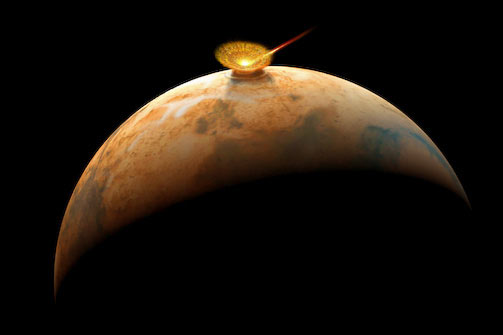
The oceans of Mars: step 1.
Water is a great material because it’s mostly oxygen, which is the most important part of the atmosphere (in my very humble opinion). You could turn some of the new Martian seas into the bulk of the new atmosphere with gigantic electrolysis plants, which would use electricity to break down the water (H2O) into hydrogen and oxygen.
If the goal is just to have life on Mars, as opposed to human life, then we may already be able to engineer something that could scratch out a living on Mars. Bacterial extremophiles, maybe water bears, that sort of thing. There’s a decent chance that there are patches of damp dirt deep below the Martian surface that could support some forms of bacteria.
The Mars impact picture was painted by Don Dixon.




Any reader of the Edgar Rice Burroughs’ “John Carter of Mars” series of novels knows that mars has an atmosphere factory which pours out oxygen rich air. Terraforming is hardly necessary.
The factory easily keeps up with the loss to the solar wind. Barsoom should be quite nice as it is.
Seriously, Physicist, you are such a killjoy. Kim Stanley Robinson said we could do it, so I’m sure it’s possible. Also, who names their baby boy Kim?
Pingback: Tenth Linkfest
It’s not that I hate joy, it’s just that disappointment is hilarious.
The one problem that was not addressed was radiation. As you stated, Mars lacks a magnetic field.
That One Guy: If we throw enough asteroids at it, or maybe Mercury, we should be able to melt the core again and get a magnetic field started back up.
Also: what about Venus? Blowing some atmosphere off a planet should be easier than trying to get some to stick, right?
Suck it Mercury! Or should I say “Jerkury”!
Also, Venus has it’s own bag of issues. It’s a lot easier to warm a planet up, than to cool it off.
Pingback: ¿Qué tan posible sería terraformar Marte? | Joaquín Montes de Oca
Terraforming the entire planet may be difficult. But it seems pretty obvious to me that the master plan would go something like this:
Humans create autonomous nanorobots programmed to build what’s needed, including other nanorobots programmed to build what’s needed, from raw materials on the surface of Mars.
For example, we launch 100,000 micro and nanorobots in a lander that we land in a crater on on Mars. Some are programmed to crawl on the surface and pick up individual crystals in the sand or soil and return to the base. Piece by piece, they build a silicon dome. Other robots are programmed to insert themselves in an orderly manner in the growing dome. As the dome closes, they pump individual molecules, or preferentially transfer individual molecules, of oxygen and nitrogen into, and CO2 out of, the dome. Within and outside the dome, robots programmed to build robots that are programmed to build robots could build, in a human generation, water supplies isolated from the atmosphere or poles; canals, transport soil most suitable for farming,,, All of these bots are solar powered, of course. When we land, the bots will already be busy working on the next colony in a nearby crater and digging and reinforcing submarsian transport tubes. I’m probably not the first to think of this, but when we land and our homes are ready-made, our energy, water, and waste recycling supply systems are in place, we will have finally put our creative minds to work.
Earth has a magnetic field because of the molten nickle iron core via Our moon 1/3 the size of earth and plate tectonics. (keeping the cookie gooey inside). Well mars doesn’t have a magnetic field could we move the asteroid Ceres (1/3 the size of mars) into orbit around mars. (new big moon) wouldn’t tidal force warm up its interior, causing plate tectonics, magnetic field and out gassing of frozen volatiles? OK, somebody tell me I’m crazy cuz we need another place to go, we need to learn how to terraform and we need to learn how to move asteroids (barney is the last of his kind)
Pingback: Mars Distance from The Sun | The information about Hood Voices
Since this is all theoretical “what ifs”, we might as well assume we can design a wormhole with one end on Mars (surface) and the other on Venus (atmosphere).
i) Assuming such a connection is, possible, how much would it take (theoretically, not actual full amount) of Venusian atmosphere to warm up Mars?
ii) Would the depleted amount be enough to cool off Venus to habitability? If not, is it even possible to estimate a possible temperature/air pressure drop? XDDD
i) Ballpark guesstimate: most of it.
ii) Even with no greenhouse effect at all, Venus is too hot for life. Terraforming enthusiasts sometimes talk about giant reflectors and orbital sun shades to help deal with the problem. Even so, Venus turns so slowly that only small colonies at the poles are likely to maintain non-fatal temperature extremes.
Huh, so in addition to atmosphere removal, you’d also have to try and slam something in to Venus to try and get it to rotate faster?
This sort of ties in to the ‘non-rotating earth’ hypothesis, then … as Venus currently rotates longer than its years, are there any guesses to how ‘fast’ (in earth days or hours) it needs to rotate for non-fatal temperature extremes?
No idea.
Isn’t the moon more suitable for colonies at it orbits so close to the earth? We could just give it an atmosphere by smashing many asteroids to increase its mass and then pouring in gasses from some source(dunno venus?, Yes a little far fetched) Is the moon in the goldilock’s zone? Also, is it possible to change a planet’s orbits in the distant future? Can’t we focus light and heat onto a specific spot from a giant magnifying glass in space? What will human do when the sun dies?
It’s definitely in the goldilocks zone (after all, it’s always right next to the Earth), so cities on the moon under clear domes could easily grow plants. Unfortunately, the asteroid belt only has about 4% of the Moon’s mass total, so giving the Moon a remotely resilient atmosphere is pretty much out of the question. It would be about as easy to make the Moon big enough to support an atmosphere as it would be to just replace it with Venus (very difficult).
By the time the Sun dies it is pretty unlikely that terrestrial life will exist at all, and essentially impossible that Human’s will still be around. Ten times the age of complex life on Earth is plenty of time for evolution to do what it does. But, if we have living descendents, they’ll have to move out.
Could we create thermal minipods that grow some sort of algae that give off gasses needed to create atmosphere & pump the gasses directly into the air there? Seems reasonable to me =)
Physicist, in your opinion, would it be easier to terraform Europa?
also, slightly unrelated question, since terraforming anything in the solar system seems very difficult would humans, as a species, be better off/more successful finding another place that supports terresstrial life and making the voyage there, however long?
It would be a lot easier to travel to a nearby star system and slightly change a nearly habitable planet there than it would be to dramatically change a planet or a moon around here (Europa included).
Mars has water its just not liquid…
what about gravity, wouldent it make you weak
PS.i`m 10
No Matthew gravity would not make you weak think about it like this. On earth lets say you weigh 70 pounds on mars you would weigh around 30-60 I am in high school and off the top of my head I don’t know the translation of weight it would make everything the same way every tool every bench press every weight you would basically still be lifting what you lifted on earth except for the fact that the weight of your weight lifting set changes to light but your muscles can still lift what they could lift on earth so on mars you could lift just saying 100 pounds more then you could on earth sooo mars gravity would not make you weaker. And yes I under stand your ten but I said this the easiest way I could think of 🙂
i agree you could not only cause plantlife on mars by this method but also create a human/mars ‘person’ who could breath the so called ‘air’.Much the same way a human was created to this planet. We have created test tube babies so we can basically create any type of life (human/ with that planet). The human dna has been entirely mapped out now. A human has all the chemical elements that are found on earth in their bodies. For a human to put life back on mars would be mans greatest achievement .. but it seems man only KILLS… so far his greatest achievement…so to create a human/mars in theory is possible… but not in my life time… you see when they built a space station in space above earth, i though they would build a space ship to find another planet with life but they have stopped… this planet cannot sustain the amount of humans on it.. certain people who buy the law and hide behind it , keep you all docile while your land is slowly radiated…. you water supply is polluted by petroleum which means your fish is killed or poisoning you…your air is polluted by people with factories… WANT A CURE FOR CANCER ?? NEVER GONNA HAPPEN,know why??? BECAUSE YOU EAT AMERICAN RADIATED FOOD… HUMAN SMART HE KILL HIMSELF AND OTHERS HUMANS STUPID , SAY “DUH , I DON’T CARE”… duh what can i do.?
SHUT UP AND DIE LIKE THEY WANT LOLOL FASTER. YOU HUMANS POPULATE TOO FAST AND LIVE TO LONG. SO, POISON YOUR FOOD , LAND , AIR and WATER… STUPID HUMANS still don’t get it even when its laid out in front of you…WHY DO I EVEN BOTHER , its not like you know what i am talking about..
What if you wanted to move back to earth. P.S.couldn`t humans try to get to mars`s core and melt the iron (i know factories today aready safely handle molton iron)
We need a world engine.
fern’s idea deserves further investigation (before the final decision is made on any terraforming master plan).
I agree that radiation is a very important issue. In fact, I consider it the top priority because it kills and also might deflate the atmosphere over time. Early Mars expeditions should seek comfort in deep burrows, meaning an underground air-tight base built by robots prior to human arrival. Solar arrays on the surface would provide the needed energy to do life-support chemistry and grow food, while waste heat should suffice to keep the place warm. Warming a surface base would require a lot more energy (which means equipment such as solar panels, wires, and batteries). The ground would provide both insulation and protection from radiation. From this base, astronauts could venture to explore the surface for relatively brief periods.
Similarly, and as a response to X man, the Moon would be best experienced as is but with a nice network of glass-walled tunnels. Various types of glass can be made from the lunar regolith, so it’s just a matter of picking the most optimal one for given resources, equipment, and requirement. Transparent glass mushrooms could allow the sun into those tunnels without compromising the seal, especially into those used to grow plants and food. I’m sure some of the plants would quickly (within a dozen generations) adjust to a month-long day cycle, although some varieties could be prepared on Earth in lab simulators or with genetic engineering. This cozy network of glass tunnels could provide a very respectable home for a number of scientists, especially astronomers who could cover one whole side of the Moon (ideally the far away side) with a crazy big network of telescopes that could spy at the sky without air to blur the view.
So to get back to the original question, here’s how I would tackle terraforming Mars, even though it seems impossible from our current perspective.
1-First, special probes would scout the solar system and gather stuff that’s not needed and easy to nudge towards Mars, such as asteroids, comets, whatever the technology of the day will allow to grab at a reasonable cost. It will take time, but essentially there would be a space-train of stuff going to crash on Mars to increase its mass somewhat, say from 1/3 to 1/2 that of Earth. This should later help with atmosphere retention, while perhaps bringing useful materials like water.
2-By mining, melting, and then casting marsian iron subjected to a magnetic field (electrically generated at least at first), robots could slowly build colossal magnets at the poles of Mars. You guessed it, this will protect the atmosphere and life from the solar wind. But this will also take time. It’s a big project, after all, since we’re talking about a new planet.
3-How to warm up Mars permanently? I’m not a big fan of chemicals and greenhouse gases, but they could help. Also helpful could be for the surface to somehow become a very dark color and to efficiently store the heat so it won’t just escape back to space at night. I’m sure we’ll be able to solve this question by the time we figure out a way to get there. Giant mirrors, either near Mars or closer to the Sun, could be part of the solution.
4-Last but not least, atmospheric pressure. Adding a lot of mass, including gas to form that atmosphere, could go part of the way for Mars to get and keep an atmosphere that could support some life, but it likely won’t be enough. Since atmospheric pressure increases as you go down, it would probably be less impossible to pick really low spots to live in, even dig them out. For example, on Earth, 1 km below sea level the atmospheric pressure is 1.12 atm, or 112% of that at sea level.
http://www.altitude.org/air_pressure.php
http://www.engineeringtoolbox.com/air-altitude-pressure-d_462.html
At about 7 km deep, atmospheric pressure is double what it is at sea level. Of course, this could be more challenging if there are also oceans on Mars, as I agree there should. Also, a region that’s too deep or narrow could suffer from lack of sun light, which affects the problem of warmth. However, in the process of dropping space material to augment Mars’s mass, care could be taken to place the pieces in such a way as to make the planet a bit less round and smooth and create big mountains and very wide and deep valleys.
Hopefully my answers inspires some form of space exploration or another. Personally, I find the Moon much more interesting because it is closer, warmer, sunnier, and full of scientific curiosities that could benefit humanity, such as helium-3 for interstellar travel and the prospect of that huge-ass astronomy base I talked about, which might allow us to see so much further and expand our understanding of the Universe ten-fold. This sounds much more exciting to me than suffering from the cold and extreme poverty that Mars would offer, although I agree that Mars should be on our list, probably next after the Moon. Ok, I’ll shut up, now.
It seems that most of us truly desire to find an answer to the possible terraforming of Mars… it’s a great thought and seems impossible right now but that is probably the way our progression has always gone… there was a time when we could not fly or go to the moon or truly believe we could accomplish that, the same goes for the invention of transport of all kinds and the silicon chip, mobile phones, radio, all kinds of medication and cures, TV etc. etc. Invention it seems is born of imagination and mostly, if we can imagine something one day it will be created. Let us then not dismiss the terraforming possibilities… it might just be a matter of triggering a “rolling process” where we start with a small area and it goes on and on until we decide to stop it… you know, like yeast … as Jesus once said “..just a little, leavens the whole”… Keep thinking on lateral lines and maybe, just maybe, we shall do it. Roger
I think the biggest problem would be how long terraforming any planet would take even if we could do it.
People seem to think that it could be done overnight or even within a lifetime when the process would take millions of years and therefore wouldn’t even be worth doing.
People seem to lack the ability to think about things in scale. It’s like how they can’t comprehend that sometimes one year gets colder even though over the vast long term our planet is gradually heating up. They see one colder year and think climate change is over 😛 They don’t seem to be able to grasp macro scale stuff like that. To be able to differentiate a tiny spike on a graph from an overall long term trend.
I see the same sort of thought process all too often.
I think it’s some sort of human limitation.
Nevermind that, people see one colder day or week and declare “oh well, I guess global warming was just a hoax”. I heard that recent years are pretty much all hotter and routinely breaking various records for hot temperature. Although I agree that even one or a few colder years would not disprove climate change. I think that one of the least talked about and worst consequences of pumping CO2 into the admosphere like it’s some fun wonderful science fair experiment is that half of emissions get dissolved in rain drops and end up in oceans where they accumulate and acidify the water. The movie The Blue Planet convinced me that oceans, even though they include marine deserts and that most of the deep remains unexplored, is where most of the planet’s life still is (land life is mostly symbolic in comparison). I don’t like to imagine what will happen when oceans are carbonated like San Pellegrino and warmer by a few degrees.
Mr. physicist could we make an infinite air source on mars with seeds and trees in an air tight dome