
Physicist: Way back in the day Edwin Hubble (of telescope fame) noticed that the farther away a galaxy is, the faster it’s moving away from us. From this he figured out that the universe is expanding, but in a very specific, weird way. Rather than things just flying apart (like debris from an explosion), the space between things is actually increasing on its own.
There’s some detail on what the difference is over here.
You’d think that, what with space itself expanding, everything else would expand with it. After all, the expansion of space is roughly analogous to a stretching rubber sheet. If you stretch the sheet anything drawn on it will stretch just as much.
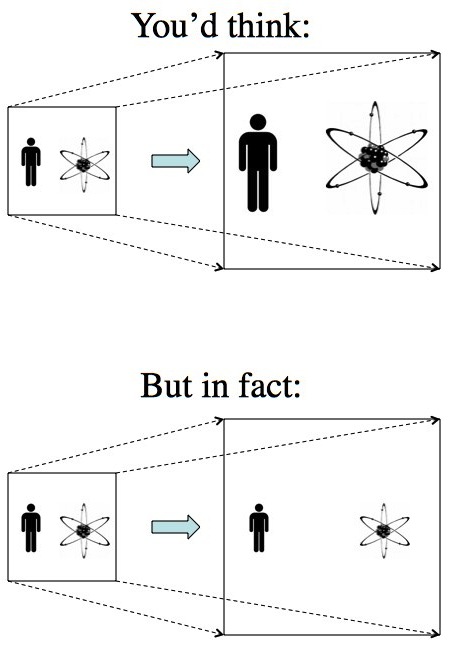
The expansion of space doesn’t cause the things in space to expand, just move apart.
But in fact, while the space between and inside everything increases, the things themselves don’t. Or at least, they snap back faster than they can be stretched. The size of atoms, their chemical bonds, and by extension everything that’s composed of them, is determined by physical laws and constants. For example, the size of electron orbitals is scaled by the Bohr radius, a0,which is just fit to pop with physical constants. 


So everything around is the size it’s “supposed to be”. At least, everything solid. Fluffier things, like stars, gas clouds, and whatnot tend to have a particular stable size. As space expands a star in that space will expand as well. However, with a drop in density comes a drop in the fusion rate, the core cools a little, and the star is free to collapse back into its preferred equilibrium size. The same idea applies to chemical bonds: atoms in any given molecule like to be a set distance from each other, and while the expansion of space may move them slightly farther apart then they’d like, they have no trouble at all returning to their original distance.
It’s worth noting that this isn’t the sort of thing that anyone would need to worry about / include in any calculations / talk about publicly. Right now the universe is expanding at the rate of approximately 72 (km/s)/Mpc (“kilometers per second per megaparsec”). This rate is called the “Hubble Constant“, which is a weird name, considering that over the history of the universe it hasn’t been constant. Unlike other physical constants, which are constant. This expansion rate means that distances increase in size by about 0.0000000074% every year. On the scale of the universe (45 billion of light years, give or take) that expansion is important. On the scale of our galaxy (100,000 light years), and especially on the scale of people (
That all being said, the Hubble constant doesn’t seem to be constant. In fact it’s increasing. So, in the future the expansion may be noticeable on a smaller scale. At some point, in the inconceivably distant future, the expansion of space may be fast enough to overcome the forces that return matter to equilibrium. Once the gravitational force of a star is overcome it’ll fly apart. Once the electrical forces that maintain chemical bonds is overcome, there goes everything else. This unfortunate occasion, is known as the “Big Rip” to juxtapose it with the “Big Bang”. The jury’s still out on when and if the Big Rip will happen, but it’s a very long way off if it does happen.



Would the ‘Big Rip’ be followed by another ‘Big Bang’? After the ‘Big Rip’, the universe would be close to a perfect vacuum, which would seem to encourage the appearance of a flood of virtual particles
I don’t think that’s the case.
Is the expansion of space equal in all locations?
Or stonger in some places, weaker in others?
It’s even as far as we can see, but the error bars are fairly big (for physics).
Even if there’s no Big Rip, an exponentially expanding universe would still eventually expand fast enough to tear apart all matter.
Isn’t that the Big Rip?
My understanding is that in an exponentially expanding universe, dR/dt = aR, while in a big rip universe dR/dt = aR^(1+\epsilon), \epsilon > 0, R the scale factor. The former expands forever, the latter blows up in finite time.
I’ve never found a good explanation of why this is the case till now! Can you also explain why this is different for light where its wavelength does get ‘stretched’ by the expansion of space?
The wavelength of light can be anything and isn’t nailed down by any preexisting laws. A single photon flying through space is always perfectly happy being at the wavelength it’s in, and never has to settle into a different one the way electrons in atoms do (for example).
There’s an older post here that talks about “cosmological redshift” (the stretching of light) a little.
Your explanation, having time stretching molecules and atoms which “snap back” sounds like a very un-relativistic idea of space (and time) to me, as if things were sitting is some bit rubber substance called “space”. In a truly metrical theory of space, the relationships between particles (etc.) are all that space is. Why not be more bold, and imagine what it would mean if shifts in quantal states, emissions of photons for example, are the very thing that define the expansion of space?
I don’t follow that last sentence?
I can’t find a better place to ask this question, so I’ll do it here.
Moving at the speed of light requires infinite energy because you are dividing by 0 in the vt/vT ratio at C. But if you were able to invest infinite energy in a mass, and move it AT C (not approaching the limit, but achieving it), T would be 0. At that point, the amount of the mass is arbitrary. It’d take just as much of an infinite amount of energy to move a gram at C as it would a kilogram, if I reckon correctly.
So could one elementary particle do it all? If a single particle moved with infinite energy at T=0, would it BE everywhere AS everything at once, accomplishing in its emergent properties every possibility, permutated as a function of time?
I don’t understand why dark energy gets stronger, over time. (It seems like it’s a repulsive force.)
My problem with that is that it means that there is more energy in the system as time goes by. How can a force get stronger with distance instead of weaker?
Where is this extra energy coming from? Why isn’t it disipating with greater distances?
—–
If Hubble saw that the universe was moving faster when he looked back in time. Isn’t that what you would expect? Thing use to be faster and now they are slowing down? Or did he see that things use to be slower in the past (the farther back he looked) and now they are faster?
Were slower, now faster.
Although Hubble’s measurements weren’t accurate enough to say that. More recent measurements are a lot better.
Just a thought – but might space be expanding more in places where there is an absence of matter? Hence besides gravity working to pull things together, there would be an outside pressure of space expanding where matter wasn’t. Could that be?
NO
Pingback: Big Bang Theory misconceptions | Blog Blogger Bloggest
Why is it that we usually hear about the expansion of space but not so much about the expansion of time? It would seem that to an observer in non-expanding frame our time would appear to be speeding up, right?
You started on the right track here: “You’d think that, what with space itself expanding, everything else would expand with it. After all, the expansion of space is roughly analogous to a stretching rubber sheet. If you stretch the sheet anything drawn on it with stretch just as much.”
But you made a wrong turn here: “But in fact, while the space between and inside everything increases, the things themselves don’t. Or at least, they snap back faster than they can be stretched.”
They “snap back” faster? How? According to what law?
“But in fact…” Really? What facts? I did not see any facts! You’re just making things up as you’re going along.
In an expanding universe everything would be expanding, atoms included. So will the measurement instruments. So, unless you are standing outside of the universe and looking in, you would not be able to detect and measure the expansion. If you were the drawing on the balloon you would not be able to tell that you are expanding. You can only see the balloon expanding because you are not part of the balloon.
If I had the time I would point out other wrong turns.
Unlike physicists and mathematicians who can dream up fantastic and magical universes where things happen by magic (not obeying conservation of energy laws), engineers have to work with what’s real and measureable.
Everything and everyone must be questioned no matter of their authority or prestige. Even those of Newton and Einstein caliber can be wrong (and are wrong on the issue of gravity).
In response to the last comment. That intrigued me for a moment
“In an expanding universe everything would be expanding, atoms included. So will the measurement instruments. So, unless you are standing outside of the universe and looking in, you would not be able to detect and measure the expansion. If you were the drawing on the balloon you would not be able to tell that you are expanding. You can only see the balloon expanding because you are not part of the balloon.”
But if that was the case we wouldn’t know we were expanding at all surely? Whereas redshift of light shows distances expanding relative to us.
Rather than space expanding, couldn’t matter just be shrinking creating the illusion that space is expanding?
“In an expanding universe everything would be expanding, atoms included. So will the measurement instruments. So, unless you are standing outside of the universe and looking in, you would not be able to detect and measure the expansion. If you were the drawing on the balloon you would not be able to tell that you are expanding. You can only see the balloon expanding because you are not part of the balloon.”
But if that was the case we wouldn’t know we were expanding at all surely? Whereas redshift of light shows distances expanding relative to us.
—-
The farther away something is, the faster it is growing apart from us, due to the expansion of space. We (and our measurement apparatus) could be expanding and we would still see redshift.
Mmmh, so the universe has a beginning (bigbang) but doesn’t have an end being the bigrip the last event after which nothing happens for ever. that sounds weird, couldn’t it be that the universe contracts at a certain point and another bigbang?
Can’t there be pockets of expanding space and pockets of slower moving expansion?
Until reading this post I never considered possible consequences of expanding space. Your example of space inside a star expanding brings up an interesting idea. If each particle inside a star suddenly found itself further away from its neighbors, wouldn’t that imply the creation of new potential energy (yikes!) since they all must fall back towards the center again?
Graffiti seen on a Mensa grade school wall:
gravity is just the opposite reaction to the expansion of the universe, so you better hope the universe never stops expanding. Cause if it does, gravity will get smaller and the dinosaurs will be able to show up again and eat us. But then pretty soon everything will just float off and time will have to start up all over again.
How does cosmic expansion play out on the Planck scale? Does ce have to be accounted for in superstring calculations? Could ce be causing superstrings to vibrate?
where is the energy coming from u ask… as theuniverse expands it expands into ( fuck knows, but i dont think its pure nothing do u ?) which is most likly fueling the universe, creating these theoryies, if into pure nothing then the bigrip will happen if into something it will expand for infinitum aint that right? until it will meet an other universe at this point well big bang will happen separating both universes with an universe.
Since “Cosmic Inflation” is just an idea and has no data to back it up, any answer could be correct.