
Physicist: The increase of entropy is just how a scientist talks about the fact that the universe tends to do the most likely thing. For example, if you throw a bucket of dice you’ll find that about a sixth of them will be 1, about a sixth will be 2, and so on. This has the most ways of happening, so it’s the most likely outcome, and for the same reason it’s the outcome with the highest entropy.
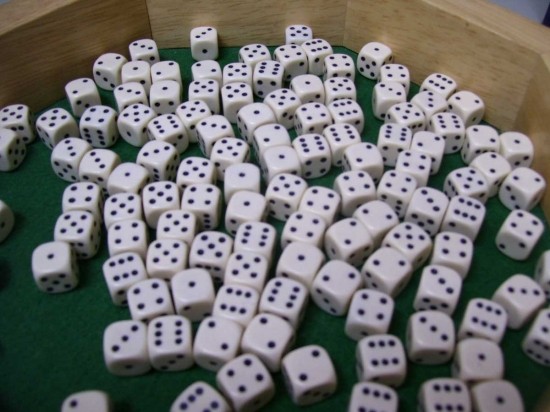
High entropy. Arrangements of lots of dice tend, over time, to end up like this.
In contrast, you wouldn’t expect all of the dice to be 4 at the same time, or otherwise assume one particular pattern. That would be a very unlikely and low entropy outcome.
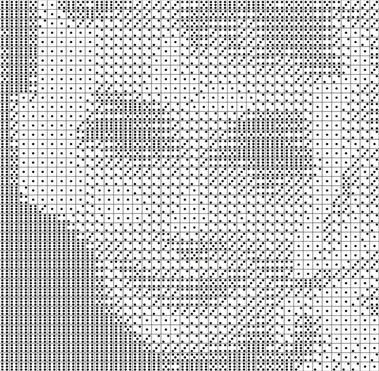
Audrey Hepburn is one of the lower entropy states you’ll find. Or rather, will never find, because it’s so unlikely. You have to sit back and squint a little to see it.
“Entropy” is just a mathematical tool for extending the idea down to atomic interactions, where we don’t have a nice idea like “dice” to work with.
One of the things that increasing entropy does is to spread out heat as much as possible. If you have a hot object next to a cold object, then the heat will spread so that the cooler object heats up, and the hotter object cools down, until the two are at the same temperature. The idea (the math) behind that is the same as the idea behind mixing fluids or sands together. There are more ways for things to be mixed than sorted.
The same thing happens on a much larger scale. The Sun, and every other star, is radiating heat into the universe. But they can’t do it forever. Eventually the heat will have spread out so much that there won’t be warmer objects and cooler objects. Everything will be the same temperature. The same, very cold, temperature. The vast majority of the universe is already screaming cold, so the heat death of the universe is just about burning what fuel there is and mixing the heat so created into the ever-expansive, cold, and unyielding cosmos. Both the burning of fuel (mostly through fusion in stars) and the distribution of heat are processes which increase entropy.
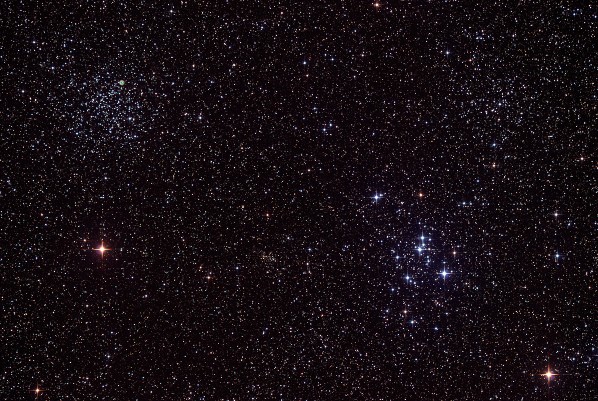
The cold and unyielding cosmos. What’s the stupid point of anything?
Once everything is the same temperature, the universe attains a “steady state”. With no energy differences, there’s no reason for anything to change what it’s doing (all forces can be expressed as an energy imbalance or “potential gradient“). Heat death is the point at which the universe has finally settled down completely (or almost completely), and nothing interesting ever happens again.
Which is depressing, but it is a fantastically long time away. There are a hell of a lot of other bad things that’ll probably happen first.
The eminent philosophers Flanders and Swann have a more up beat take on the heat death of the universe:
“Heat is work, and work’s a curse,
and all the heat in the universe,
is gonna cool down. ‘Cause it can’t increase,
then there’ll be no more work, and there’ll be perfect peace.
That’s entropy, man.”




What is behavior of radiation in adiabatic condition
Many, many, many years ago I seem to recal a comment in an Isaac Asimov Book called (I think?) Inside the Atom, that suggested – once the Unviverse has fully run down – pretty much any remaining matter would be a very stable isotope of lead.
Can’t recal if it was predicted that, that would – for ever more – remain part of the final state of things. Assuming I’ve accurately recalled what I read way-back-when, but was wondering if a dull, motionless, lead-filled universe is still – today – considered the likely fate of the cosmos?
Anything with a beginning is wrapped up in a time-space capsule, carries an expiry date. Since, admittedly, the Universe has a beginning, it is also in a time-frame. The ‘Time’ dimension helps conformity. Doubts, if any, can be only on’What then?’ The major religions differ on this, Indian Faith saying that the Universe is cyclical in existence, it lies submerged in a time-frame only to re-emerge to same old form, and for the cycle to repeat endlessly. To the question, why this ‘play’, the Upanishads answer ‘it is Brahman’s past-time’.
I buy that KVNarayanmurti. If the universe is finite and has a beginning and end, then there is something else outside the universe which is infinite and has no beginning and no end and for which entropy is totally stable, with some universes expanding and others contracting. Unfortunately, our poor little brains can’t interpret things that are not finite. On the other hand, I think if I was Brahman, I’d be pretty bored by now, but our poor little brains always have to give a reason to this infinite thingy, so we generally associate some kind of superior spirit with it. But why stop there? I reckon that Brahman is probably wondering about he/she/it’s existence and reckon he/she/it is just the pass-time of something above him/her/it in the “spiritual” (if you want to put a name to infinity), dimension. To sum things up, I’m OK with entropy always increasing at the “universe” level but in an infinite time/space scale, I would propose that it’s stable (unfortunately, I don’t have a mathematical proof of that. Will a hunch do?)
Entropy is defined mathematically as s=dQ/dt. In our solar system heat is generated everywhere including solar fusion and radiated heat from planets. dQ is therefore always a positive number. This is the reason that in our known universe, entropy s is always positive. But in another universe such as black holes, energy as well as mass are swallowed and the energy Q is converted backed to mass to formed a very densed mass in the core of black hole. In this situation, heat Q becomes a negative value, and s will be a negative value. So it is possible to have a negative entropy if your definition of universe includes black holes or neutron stars.
I wonder when someone no matter how credentialed uses the word “infinity” as if it were within human grasp. There are far far more positive, creative, good ways to expend mental energy. There are fellow humans within a very short distance (a few hundred feet) from you who are in need of your help. They are suffering at this moment due to poor circumstances, uninformed decisions, (or entropy, if you like). I assure you that their suffering, whether understandible by you at this moment, is finitely now.
Please use a few equations to show why the entropy of the universe is always increasing
According to the Indian Vedantic philosophy, the entire Universe is manifested in the mind, as real as ‘in a dream state’. On wake-up, it ceases to exist as perceived. While in ‘deep-sleep state’, everything perceived is ‘non est’, on wake-up you admit ‘I knew nothing’. Christian Science is also increasingly veering round to the view that our entire perception is unreal. The perceiver, the perceived and perception are the same ‘Brahman’, the reality. Like in darkness, one mistakes a rope for a snake, when light is focussed, reality shows up. Your reference to human wants and sufferings is also similar.
Entropy as described by Thermodynamics seems to be a fragmented element of science and only a part (ala David Bohm) of a more complete understanding of everything. There are pockets of existence which demonstrate a reduction of entropy – obviously. If you use human intelligence/thought as a model and recognize it as relatively coherent energy, then it is arguable that coherence has increased with population. If AI expands as predicted, that type of coherence will extend more quickly into the universe not fettered by the needs of a biological machine. Heat death, absolute zero, speed of light are all things we apes barely understand but they’re fantastic to think about.
The macrostates with the highest entropy are more probable, of course. But it would mean that the Universe would be moving in microstates from macrostates with the highest entropy. No relation with the non decraising of entropy. If we do a temporal inversion, the entropy doesn´t increase any way. That is not the reason
The reason is that we divide the Universe or any other system into measuring device A, observed system S, and environment E.
The observed system is the parts (not necessarily the geometric division). If we make a measurement, the S + A system decreases the entropy (collapse, division of a branch, depends on the interpretation, but a branch or the state after the collapse has a lower entropy)
The entropy of A + S + E increases, because even when measuring S with A, there is interaction with the environment and, by definition, the state of the environment is not measured. Then, the entropy with this division of the system increases, if we look at the system from another system (we are calculating the evolutions outside the A + S + E system), and in statistical mechanics, we do not consider a microscopic measurement of the thermodynamic system, then entropy increases
I use “increases” and “decreases” in a non-strict sense, “increases” includes non-variation and “decrases” also Then, the entropy with this division of system increases, if we observe the system from another system (we are doing calculations about evolutions out of the A+S+E system), and in statistical mechanics, we don´t consider a microscopic measurement of the thermodynamical system, then the entropy increases
I use increase and decrease in non stric sense, “increases” includes non variation, and “decrases” too