
The original question was: I know that if you hit water at a certain speed it is supposed to crush your body like you have hit concrete. Is this the case for all liquids or is something to do with the surface tension of water and if you hit a gas in a confined space fast enough would it feel like hitting concrete?
Physicist: There’s nothing terribly special about water, and even hitting a gas fast enough would “feel like concrete”. For example, when meteors (which are fast) hit the atmosphere they generally shatter immediately.
A good way to think about high-velocity impacts is not in terms of things (like water) acting more solid, but in terms of things (like people, rocks, Fabergé eggs) acting more fluid. The more energy that’s involved in a collision, the less important the binding energy (the energy required to pull a thing apart) is. A general, hand-wavy rule of thumb is: if the random kinetic energy of a piece of material is greater than the binding energy, then the material will behave like a fluid. A bit more energy, and it will fly apart.
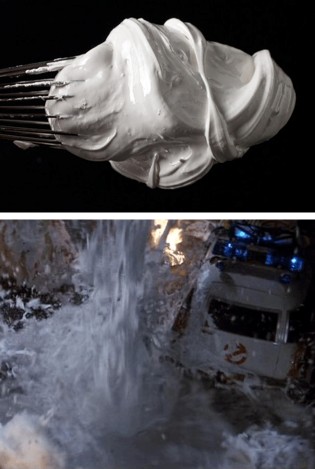
Whether a substance behaves more like a solid or more like a liquid depends on the energies involved.
This shows up on a much smaller scale as well. For example, the difference between water and ice is that the random kinetic energy of water, better known as “heat”, is greater than the binding energy between the molecules in ice.
So, when you fall from a great height and land in water there’s a bunch of kinetic energy going every which way. The water continues to behave like water, but since the kinetic energy in different parts of your body are greater than the binding energy keeping them connected, then the body as a whole will act more like a fluid. That is; it’ll “splash” (in the grossest sense).
Clearly there’s a big difference between something breaking into chunks, and something liquifying, but that difference is mostly just a matter of energy; it takes more energy to make sawdust than wood chips, but the process is more or less the same. The take away here is, there’s a lot of different kinds of binding energy (molecular, structural, etc.) but they all do similar things.
Professional fluid dynamicists use a value called the Reynolds number to quickly talk to each other about this property in fluids. It essentially describes whether a fluid is more “inertial” (water-like) for values much larger than 1 or more “viscous” (honey-like) for values much lower than 1. Being natural comedians, they’ll say things like “usually my half-and-half has a Reynolds number around 20,000, but this morning it smelled weird and had a Reynolds number of 0.3!”. It’s usually used a ballpark-estimate, short-hand-description kind of thing, but in general the Reynolds number gets larger when things are bigger, faster, and denser, and it gets smaller when things are more viscous.
So, in a very, very hand-wavy way, a fast moving body hitting water (or whatever) has a higher Reynolds number, and is more waterish itself.
The “solid” marshmallow picture is from here, and the Ghostbusters “liquid” marshmallow picture is from Ghostbusters.




So in a high velocity impact with water, what’s the best way to disperse energy in a manner that involves as little fluid body parts as possible?
In the language of the post, you’d want the movement of the water to be “less random”. It’s the shearing of forces that really messes things up. So, streamlining yourself is the best way to survive a terminal velocity fall into water (like a dart).
Even so, don’t expect to live or stay conscious.
Pingback: [GVGT] 2 Crazy Russians climb 1000 feet bridge! - www.hardwarezone.com.sg
The water molecules that forms the surface of the water posses a surface-tension (i.e. a weak inter molecular force between the layers of molecule… The inter-molecular force remains within the surface molecules unless these molecules were disturb by an external force and thus acts as a concrete when an object falls from a great height…….!!!
Mythbusters did a whole thing about that in the “hammer drop myth” (where did we get examples for stuff before that show?). Turns out the surface tension doesn’t factor in appreciably.
I am again too late to comment but in my humble opinion it is easier to predict what will happen by using the drag formula P=1/2ρv^2Cd. Once you have the pressure you can compare it to compressive strength of the matter (or is it tensile? or shear?) and see if it disintegrates. But that is only good for rigid solids. For living beings and most man-made objects (cars, planes, phones, laptops etc) that have delicate internal structures you can calculate the acceleration.
Let’s see what happens:
Drag coef. of man=1
Density of water=1000 kg/m^3
Terminal velocity=50 m/s
Cross sectional area of man=0.6 m^2
Mass of man=75 kg
Therefore:
P=1.25 MPa
F=750 kN
a=10000 m/s^2
About 1000 gs! Not a single bone survives. (I suspect it should have been 770 gs, the density ratio of water to air)
First of all apologies for my bad English. Neither am I a native speaker nor Mathematician or Physicist ( I just posses a Major in Computer Science) so it would be great if you could, if you like, answer my question like speaking to a child 🙂
Second of all. I read your article with great interest and liked it a lot.
To the question which bugged me since I read your article:
Is there a point where the displacement of water factors in? If there is a point where is it and could you elaborate on this topic a little more?
If we had a cylinder full of water and a cylinder head which we would try to push into the cylinder we would not be able to displace any water and would find heavy resistance because we would try to compress the water.
If we had a huge object like a big solid ball of steel ( perhaps 50m in diameter ) and we would let it fall into the ocean at maximum atmospheric falling speed, there would be displacement of water. In the process of displacing the amount of water needed for our big object, which will not happen for free I suppose, my guess is that huge amounts of water (big object) would be moved fast (high impact speed). To accelerate objects with mass energy is needed. To accelerate massive objects quickly lots of energy is necessary.
At this point I would really like to know if I made any major mistakes in my reasoning and if not at which point the energies I mentioned come into play.
Had a question that maybe someone here can help me out with. We are looking at training in multiple locations on a helicopter and the survivability of a person falling on a regular ground surface like a dirt road versus concrete. We conduct training with a recue hoist system and sometimes this includes hoisting people from buildings, urban enviorments and vartied terrian. The argument we are having is I believe based on false perceptions of falling or impacting something like a dirt road versus a concrete pad. Half of the group believes that falling on something like a hard packed dirt surface is more survivable that falling on concrete. Any anyone can assit me in this I would greatly appreiate it.
@Travis.
Neither… My understanding is that winching operational training over a solid surface of any sort is no longer legal in Australia. You must do winch training over water. I pointed this out to some military pilots who proudly explained that civil rules don’t apply to them. About a week later a winch motor overloaded, burnt out and applied power to the explosive line cutter. I understand that they didn’t die, but they didn’t do much tangoing afterwards either. Moral, don’t fall onto anything that you’d be unhappy about jumping onto intentionally.
@Travis PS, they were training over the grassed parts near the airfield. Grass is softer than a “dirt road” (the softest of your options) and they really really didn’t enjoy it at all.
I think i saw an article somewhere that stated a fall of only 18 inches is sufficient to break a bone under certain circumstances. So any kind of winch training over a non-water surface would entail some risk. I mean, imagine your emergency room visit just jumping off the roof of your house.
So, just for fun: What is the reynolds number for a fluid that a human could fall into, traveling at terminal velocity, and survive? Lets give the premise that an average human can survive 100 ft fall and terminal velocity is 120 mph. And lets ignore body posture.
Scientists that use words like bunch or hand wave piss me off
Pingback: Q: Is it possible to parachute to Earth from orbit? | Ask a Mathematician / Ask a Physicist
How high does a human have to fall from for it to feel like concrete when hitting water?
Surface tension of water gives much easier than the surface tension of concrete. The initial impact does the damage with the water, once that surface tension is broken that impact pressure reduces greatly. With concrete that impact pressure does not reduce at all. It is a dead stop, water gives and its a slower stop. Will still kill you, but the idea that water is ‘like concrete’ isn’t really true. a falling body will always break the water surface tension and sink, this will not happen with concrete.
A simple answer:
Concrete is a solid and so it doesn’t compress very well (so it hurts if you fall on it)
Water is a liquid but the molecules are so close together it doesn’t compress very well either (so it still hurts, ALMOST as much as it would had you fallen on concrete).
Think hydraulics, we use liquids as they don’t compress easily.
How much it hurts depends on the force you land with. Impulse (impact force) = mv/t
M is mass, v is impact velocity, t is the time you’re in contact with the ground for. Hitting concrete or water will have a small time (as your body will just bounce back up straight away by a few mm), so the impulse is higher
Hitting something soft or something that absorbs the impact like a trampoline or stack of feathers increases the time so the impulse is MUCH MUCH lower.
My son drowned from jumping from 25 metres (82 feet) into water. Would he have been unconscious when he hit water ? He was in a half belly flop. Any answers greatly appreciated.
@SANDI
I’m really sorry about what happened to your son. That’s heart breaking.
Physicists are a million miles from being medical experts, so the best I can do is guess. How someone responds to an impact depends on how fast they’re moving as well as how they’re positioned at the time. A doctor presented with all of the facts may be able to tell you what your son experienced, but it may be impossible to know for sure.
hi
Sandi, so sorry to hear of your son’s passing and the reason. Our nephew was the world’s high DIVING Champ many years ago and DOVE from 84 feet I believe, into only 7 feet of water in a round “pool” about 12 feet in diameter. Your son must have hit wrong when he hit the water. Had he done this previously or was it the first time. There is a very special method of doing this and he should have been instructed by someone very experienced in high diving. I look at death as being the result of God needing the soul of specific individuals and when it is the time that the Good Lord needs them, they are going no matter what they are doing. Again, we are so sorry for your loss. Time heals much!
I water skied from the time I was 9 until I was 43. At the age of 13, I stopped with pairs and went to slalom, tricks skis, jump skis, shoe skis, barefoot and more. At the age of around 36, I was at a very large lake in southern Indiana and had skied all day. A guy approached me in the afternoon and asked if he could pull me behind his drag boat. This was many years ago when drag boats did not run nearly as fast as today but still well over 100 mph. I asked if he had a long rope and he said he had a new rope never used at 125 feet. STD length is 75 feet to 85 feet. At around 115 mph in a straight line, the rope broke. All hell broke lose as it was like a pipe had been placed in front of my ankles because of the rapid slowing down. I hit face first, of course and then tumbled head over heels. The fifth time I hit, people in the boat knew I was out because they had seen me digging in the water to keep from coming back out but then my arms and legs flew wildly. They estimated I hit about 30 times. When they got to me, my eyes, my nose, and one ear were bleeding plus I had bit through my lip and could see zero light for just over 2 hours. My parents were there and saw it happen and insisted I go to the hospital but I refused. After my sight returned, I wanted to go skiing again and my father determined I was crazy (LOL). But I explained that if I did not go out to ski for at least 10 minutes, I might never ski again. He understood, the time passed fast and I skied about 15 minutes and then dropped off and we went home. That accident probably ruined my spine as now I have major spinal problems that began in thoracic area which would have been injured more than likely from the tumbling at those speeds and in consideration of the hardness of the water at those speeds. I continued to ski for another 7 years and would love to do it again at my now 75 years but with my spine almost destroyed, I will remain off the skis but I truly loved it and it was the only sport I was good at. I had never been injured until then and thus had no fear of doing anything and was often challenged to do special new tricks which I always attempted which resulted in multiple falls, but that is just part of water skiing. I would love to know the force that I was hitting the water at when I fell at 115 mph! And no, I did not have speed skis on but regular skis that were flat bottom with a very small fin. Most of the time I was on my slalom ski or barefooting it except of course if I was jumping. I wore a foam ski vest that covered the majority of my front and back sides that a DNR officer told me if I ever fell hard it would rip apart. Of course, he didn’t know what he was talking about as he recommended I wear a belt which are dangerous as they can be pushed up to the center of your chest and prevent you from breathing if they are too tight there. My vest kept me upright when I was unconscious which saved my life in that accident or I could easily have drowned before they got to me. I also believe that all people should have a license to operate a boat and should have to go through a safety course and demonstrate they know the laws on water which too many do not. Have fun, be safe, use your head.
I typed it fast above and noted the errors but could not find a way of correctIng them by editing what I had posted – SORRY!
What about being heat by a fast boat.
While you’re swimming.
The boat weight 2000 kl
Velocity 40 kl x h
Can you calculate that .
Which force hit this men.?
What about being hit by a fast boat.
While you’re swimming.
The boat weight 2000 kl
Velocity 40 kl x h
Can you calculate that .
Which force hit this men.?
I imagine that it would be hard to time, but if someone, like a soldier, threw a hand grenade into the water below them as they were falling so that it blew up and broke the water tension, couldn’t they survive a fall from substantially higher height?
Okay I have a question. Is there any way I could harden the surface tension of water to the point that it feels like concrete? Without having to fall from a substantial distance. Instead is it possible to generate the same amount of force constantly or in pulses on tge surface of water for it to stay sturdy?
@Velka
Pouring concrete in it would do the trick.
The surface tension of water kinda is what it is, so if you want to change it, you’ll need to add something to change the water.
This discussion reminds me of the Challenger accident in 1986.
It is said that the capsule/command module of that space shuttle blasted
apart from the remaining rocket beneath.
I always wondered why that fall into the water wasn’t a survivable fall?
Would it have mattered if the command module was more of a teardrop configuration? The point of the tear entering the water rather than the broad
aspect of the tear shape?
So does that mean if someone falling with a high KE fell into running water with high KE the impact would not be as “intense” as opposed to falling into “stagnant” water which would have a lower KE?
I am surprised that no one has mentioned this yet, but did you know that the cat (the cute furry house cat) is capable of falling from extraordinary heights and yet is still able to survive completely in tact. But there is one caveat– from a shorter or mid-level height would have a lesser chance of survival. This is due to the fact that fromthat from a higher altitude the cat has ample time to twist and turn in just the right fashion to achieve a perfect balance as well as well as knowing the exac time to cushion itself itself in the most maximum way to avoid such a blunt force collision with the ground. Now, just think for a moment as to the degree of such acrobatic agility that requires.
I’ll take the bait.
Yes. Everyone, almost certainly knew that. Humans are not as low weight/drag. …actually if you want to have some fun you can read this literal thread and learn so much about terminal velocity calculations.
Pingback: Lebih sakit mana jatuh dari atas gedung ke tanah atau jatuh dari pesawat ke laut jika dari ketinggian yang sama? - Fajrul Fx