
Q: If atoms are mostly made up of empty space, why do things feel solid?

Physicist:

(The following paragraph is wrong.  Like, really wrong.  There’s a redaction here: My bad: If atoms are mostly made up of empty space, why do things feel solid?)

As atoms get too close to one another their charges begin to repel each other.  Once they’re close enough that they can “see” the other atom, the electrons on the near side of both atoms begin to repel each other and move more to the far side of both atoms.  This leaves the positively charged nuclei facing each other.
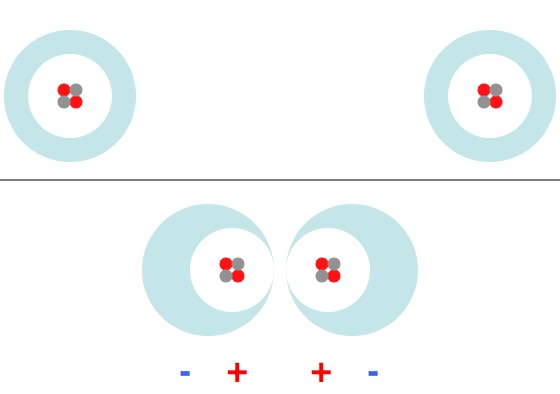
Electrons swarm around the nuclei of their atoms (in this case Helium 4). When they're brought very close together the electron clouds shift and the atoms briefly polarize in such a way that they repel.

Basically, when two atoms come too close they behave exactly like magnets brought together with the “north” ends pointing together.

(Everything up to here has been wrong.)

This certainly isn’t the whole story.  Quantum chemistry isn’t rocket science, but it’s still pretty complicated.  Atoms can share electrons, or their electrons can move so that they behave like attracting magnets, and a whole mess of other things.  For example, attractive van der Waal forces can show up when atoms are close, but not too close.  Slight fluctuations in the arrangement of electrons in one atom induces a sympathetic arrangement in nearby atoms (this is more specifically a “London dispersion force“).  As a result, the atoms end up with dipoles lined up in a “+-  +-” way, instead of a “-+  +-” way, like in the picture above.

In general, the force is extremely small.  But it is just strong enough to hold liquid helium to itself (otherwise it would be a gas), and hold geckos to walls.

Geckos have weird feet because they have evolved to optimize the chance of random dipole interactions between the atoms in their feet and the atoms of whatever they're climbing. As a result, they can climb vetically on materials as smooth as glass. Pictured here is a gecko excited to learn that someone remembered his birthday.

Addressing the fact that matter is mostly empty space, if you really squeeze matter you’ll find that the electrical forces can no longer hold atoms apart.  Basically, they find that it’s easier for the electrons and protons to fuse together and form neutrons.  Once all the charges are out of the way the atoms (now balls of neutrons) are free to collapse together.  At that point the only thing holding them apart is “Pauli pressure”, which is fancy quantum physics speak for “they can’t be in the same place”.

The only time this happens in nature is in neutron stars.  To get an idea for what happens when you “deflate” matter: If you were to crush a 50m Olympic size swimming pool into neutron star material, it would be about 0.05mm long, which is about the width of a single hair.


This entry was posted in -- By the Physicist, Particle Physics, Physics. Bookmark the permalink.

30 Responses to Q: If atoms are mostly made up of empty space, why do things feel solid?

  1. Carl Pham says:

    Your answer, while plausible on its face, is not correct. Electrostatic interactions have essentially nothing to do with why matter feels solid. As you point out yourself, at close distances the fluctuations in electron density result in attractive, not repulsive, forces.

    The source of the ultimate “excluded volume” forces is entirely quantum mechanical: it is the fact that electrons are fermions, hence (this is the Pauli exclusion principle) cannot occupy the same volume without being in different energy states. If you attempt to push the orbital electrons of two atoms into the same volume of space, most of the electrons will need to be promoted to much higher energy states. The requirement of a great deal of energy to move the atoms closer is what we interpret as a force. You might call it an “exclusion” force, because it comes from the exclusion principle — but it has no connection at all with any of the canonical four forces, and in particular it has nothing to do with the electrostatic repulsion between electrons. It would operate even if the electrons were uncharged.

    For an easy way to see this, recall that neutron stars are held up against collapse due to the force of gravity by exactly the same exclusion forces — and, of course, neutrons have no electrostatic repulsion, being uncharged.

  2. Pingback: My bad: If atoms are mostly made up of empty space, why do things feel solid? | Ask a Mathematician / Ask a Physicist

  3. Gulam Mohd Qadri says:

    if we consider earth than earth is composed of atom together and it is suspended in space , all matter gases dust are suspended in space , as such space is not made up of atoms , space is only a reality which has permitted to atom to stay within him whether space and time is also created is not easy to explain even by scientist . Only posibility that even space is created is possible if there is entity more special than space that could be consciouseness a creative point from where every thing is created . In answer to if atom is mostly empty space sorry atom is smallest particle a solid and within the solid is the empty space as such the atom bulk together is solid , liquid and gas but not empty space , empty space is a ocean in which atom are like fish

  4. Mr. Physicists? … What about the scanning tunneling microscopes? They photograph atoms and the photo’s are little rows of pyramids door to door. How does that fit with the theory that you are using? (They also show a lattice structure)

  5. The Physicist The Physicist says:

    The scanning tunneling microscope can’t take pictures (if it could, it would just be a microscope). What it does is very carefully runs a current between the tip of a very sharp needle and the surface in question, and measures that current. The greater the (tiny) current, the closer the surface. This technique is accurate to distances smaller than atoms, so when that surface is made of atoms (and when isn’t it?) it appears bumpy. The fact that the atoms are mostly empty doesn’t enter into it.

  6. So you assume the current is flowing around the tiny solar system model and not through it giving images that appear to be pyramids door to door? I know that the Bohr Atom is an accepted model and that the study of chemistry works with it. But you can trouble shoot an electrical circuit with a diagram that does not look anything like the actual circuit. What makes people think that the atom looks like the Bohr model and not like the images they see? Those images could also be forces and nothing solid. Weight could be forces and not mass. With the Tunneling microscope we at least have an image instead of just our own imagination.
    In the beginning logic tells us that Emptiness, the laws of God, and time was all that was present. That stands to reason that atoms do not contain anything solid and are only forces. I might sound like someone trying to make something out of nothing, … LOL … but I have reasons for asking what other people think. If you will try to stay with me it will be a big help to me.

  7. The Physicist The Physicist says:

    Well, it’s not an actual direct image (readers who’d like to see what we’re talking about, here’s some images), it’s more like a painting of the bottom of a murky river made by someone who’s poked it with a stick.
    The understanding of the structure of atoms (specifically their emptiness) didn’t really get off the ground until the Geiger-Marsden experiments. In those experiments alpha particles were fired at stuff, and rather than most of the alpha particles slowing down (by pushing through material), the vast majority of the alpha particles passed through without slowing down, and a tiny few bounced off of something very small, very heavy, and very charged (what we now call the nucleus).
    Up until then everyone just assumed that matter was, more or less, “full”.

  8. SOLIDLY E t h e r e a l
    — James Ph. Kotsybar

    We’re made of stuff that’s hardly even here
    composed of atoms that are mostly space.
    The solidity with which they appear
    happens because their trapped electrons race
    around the nucleus — near light speed fast —
    and always possess a negative charge
    that wont let other negative charge past.
    They also make the atom appear large.
    Around the nucleus, that is tiny,
    electrons blur to a far distant cloud.
    Were we their size, we wouldn’t even see
    the nucleus we’d remotely enshroud.
    The percent of empty space we define i
    s ninety-nine point nine nine nine nine nine.

  9. I like your painting of the river bottom but I noticed that you did not mention the lattice structure. Do you have any idea of what the STM is seeing in those images?

  10. The Physicist The Physicist says:

    Those are atoms.
    The point is that they aren’t being imaged directly. The fact that they appear solid is just an artifact of the method we use to detect them.

  11. Paul says:

    I know very little about this field, but it still interests me . First, could you explain this to someone that doesn’t really understand this subject. You’re saying that despite nothing being solid at an atomic and sub atomic level, things are solid because of electromagnetic reactions that fill the space with a magnetic force or maybe some sort of energy ? Also, is the “measurement problem” anything beyond a theory and does it have much validity, plus, how did they ever test a theory where an atom does not show up until it is observed? Thank you for any replies.

  12. The Physicist The Physicist says:

    I fixed this post, because of its wrongness. Update here.
    It’s a little more subtle, but basically yes; electromagnetic effects keep atoms from getting too close.
    The “measurement problem” is, to a large extent, the “Copenhagen problem”. Ignoring the measurement problem, by assuming that wave functions never collapse, is a one-way ticket to the Many Worlds Interpretation, which seems to work just fine (without these kind of problems).

  13. Xeon says:

    so oke im not like you guy that know every thing about this but i like to ask some thing’s.
    you guys only talk about the negative and positive size of the atome like a magnet and the space between,
    why is it that there is nothing that can make the same reaction than ohter atoms,
    like… say get a magnet lay it on your hand,and it makes (lets say) positive energie to your hand but it wont stiky on your hand like it does to metal,
    what if it have the same positive energie as a atoms than you get “+- +-”
    is this how the Geko does it ?
    so the Geko have the “+- +-” in his feet to climb on any thing he is on.
    what if we can make some sort of machine than preduce the same energie force?
    1.wil 2 atoms fuse together than and make some thing new?
    2.or wil it pass through the ohter atoms?
    because they have the same energie so there is nothing than wil stop the ohter atom from going through.

  14. The Physicist The Physicist says:

    We have made some machines (materials) that produce the same force. The gecko’s hands and feet don’t actually produce a force, but instead just optimize the forces already present. It’s a subtle distinction.
    Two atoms fusing is a nuclear reaction, and two atoms bonding together is a chemical reaction, and the van der waals force (what geckos use), is far weaker than both.

  15. Trevor lee says:

    Am almost sure that consciousness is what makes the universe ! As nothing is really solid at all and eventually if you go back beyond the big bang everything came from nothing absolutely nothing .

  16. Jonathan Stowe says:

    Motion of the atoms prevents anything from passing through it. Like if u walk past a chain link fence with a 3/4 inch steel bar and try to put it through the fence while u r walking it wont go through the links in the fence. If u stop the bar fits through the fence easily.
    And/Or, Anything we could try to put through an atom is to big to fit between the particles that make up an atom. Like if u try to put your whole hand through a chain link fence, it wont pass through the fence. This happens because the links (or particles) r to close together for your hand(or an object) to pass through it.
    So…. I was wondering if one or both of these theories was correct??? Send me an eMail if u can answer my question. [email protected]

  17. The Physicist The Physicist says:

    The central idea of “solidness” is not that something is solid because it’s there, a thing is solid because it exerts a substantial force on things that come close enough. If two types of “stuff” only generate forces that the other ignores, like one generates and responds to electric force and the other generates and responds to the nuclear strong force, then they’ll seem completely insubstantial to each other.
    We see this in nature. For example, neutrinos are a type of particle that is unaffected by both the electric and nuclear strong forces (the primary forces involved in ordinary matter), and as a result they may as well be ghost particles: their density and speed have no impact on whether or not they feel “solid”.

  18. saikat shome says:

    First of all, Atom does not made up of empty space, its contain mass and also charge,

    an example= h+ contain one proton and one electron, and electron contain -ve charge and proton contain +ve charge, or say proton consist +1 charge,

    1st= if we break electron then we not find any sub-particle inside electron, so electron has consist no sub-particle.

    2nd= if we break proton then we find three elementary particle inside proton , called two up quarks and one down quark, two up quarks consist +2/3 charge and down quark consist -1/3 charge ,

    this makes = 2(2/3)+(1/3)= +1ve charge(proton).

    after quarks ,there is no subatomic particle inside quarks.

    let assume matter= empty space(null).
    then let we know that —-every action there is opposite and equal reaction.— eqn1

    so let “A”=matter.
    and “B”=empty space(null).

    then we know that matter is travel in space without any contradiction or freely move.

    let “A” has speed= 23 km/hr.

    also we know that matter can travel in empty space.

    if B=A.
    then “A”= 0 km/hr speed. from(eqn1)

    if ” empty space =matter” then all the matter present in universe is unable to travel in space. and we know that we can travel and we have speed.

    so this is false that “Matter= empty space”.

    and therefore matter and empty space is different .

  19. Michael Turner says:

    With understanding fundamental particles the human experience has historically always been wrong. What ever we claim to be fundamental, we always find something smaller. Yet we still can not extrapolate to a full understanding.
    I believe we are missing something simple which explains the overall framework of the universe quite nicely.
    Galaxies are continually losing overall energy, yet we do not think about it. galaxies like atoms, absorb missing energy on packets of quanta, specific energy states, but what if there is a process going on that gas been completely missed because we never thought of it and it is hard to detect do to the nature of the process. As a light burns bright and does not deminish brightness over time because it is continually hooked up to a replenishing power source, so to does mass and energy decay onto the aether of space by giving off a gravitational wave, gravitons bound irreversibility in a monopole gravitational wave. Time and space are actions of this process, influenced by the density of space itself around the mass and energy decaying. Gravity is the reaction to the gravitational waves actions of forming wavefronts. This is how the universe’s stage is continually set up. Dark energy, black hole evaporation, gravity, energy loss in a closed system (1993 Nobel prize in physics) all lead to evidence that a hidden variable is present. I am describing the hidden variable and it’s process. Although fundamental particles allow time to be consistent. It is still in the long run just bound gravitational waves eventually decaying creating space itself.
    Simple question; if the singularity was finite containing mass, energy and space and space is increasing then mass and energy have to be decreasing for space to increase, and space is the lease potential firm of energy. If the singularity is infinite then all the law of physics are broken because the very universe itself becomes a perpetually motion machine and it violates it’s own laws.
    Sincerely,
    C. Michael Turner

  20. donald cheatham says:

    CONCLUSION
    We are not even really here other than in human awareness
    It is that simple.

  21. Jack says:

    Im a grade 11 Chem student just curious about this article. I don’t have the education or knowledge that some of you may have so go easy on me! If atoms do have spaces in between them, is it true that in essence all solids have holes that go right through them? Furthermore, is the only reason it appears to be complete solid is because it’s on a microscopic level?

  22. Shane Schofield says:

    I think we’re over thinking the question abit.
    As a general rule electrons hang around their own nucleus (that’s obviously your atom) – These atoms are Tiny! Soo tiny we obviously cannot see them but they’re are unimaginable numbers of atoms in the universe, these all huddle around eachother (i forget why)
    The vast numbers in one place could be likened to swarms of insects, you cannot see through them.
    Clearly an object, like a wooden desk, has far more atoms huddled together than that of gases (because atoms when hot have enough energy to overcome the forces drawing them together)

    Of course I may be wrong, I know very little, I’m intrigued by all of your opinions. Many of them are valid on a sub-atomic level but we don’t see the world that way (i imagine due to our visual light spectrum)

  23. John R. McMillan says:

    Please overlook this comment if it offends your sensibilities. I really wish scientists who believe in God could take a hard look at how the spirit world with its angels and former angels who pretend to be ghosts etc can “walk through walls” etc. Our growing awareness of Dark Matter/Energy seems to provide a logical starting point since it doesn’t interact with baryonic matter. OK, so even to address pure atheists – such a study may yield surprising results if undertaken from this bias, even if you think it’s ‘nuts’. Think of it as comic book fantasy if you like.
    So if their ‘matter’ is completely THERE but doesn’t interact with our ‘matter’ how would you argue that it’s possible (even if you think it’s a ridiculous concept)? Could it simply be a matter of their nucleus having a negative charge and some other quirk about their “electrons” (for lack of a better word).
    If you ever took Debate in school and had to argue in behalf of something you actually thought to be wrong or crazy, then you might be up for my challenge.
    Thanks

  24. Malcolm Diamond says:

    Scientists vs Divine intervention, a classic debate in itself. One that can be answered simply. One day those “religious” people who shun scientific views may come to the logical conclusion that if god created everything, then he created science for us to better understand how he did his biggest trick… the creation of life and everything. Wouldn’t you agree that God must be the ultimate scientist? But regardless of the personal religious beliefs of anyone reading this that wasn’t the question originally asked, so lets not hijack the topic to further some personal agenda. A lot of what we know of the internal working of atoms is personal belief based on the logical things we have knowledge on based on our investigations so far. We know atoms have mass, we believe that the “charge” of an atom must be because of the internal structure of the atom. We know about magnetism and about repulsion and attraction in magnetic terms. We have seen images of atoms from electron microscopes, and have even seen movies made from time lapse shots of atomic fields evidently moving. We assume from what we know of atoms and their physical mass that their must be a lot of space in their structure given that if our understanding of atoms is correct, there must be. We still do not fully understand the internal workings of an atom, this is evident when differing views of what an atom contains, how the electrons orbit (or not) whichever is the case exist. Sure our understanding is growing, but we do not fully understand yet, that is why there are branches of science dedicated to this subject. It is logical to assume that a steel box is hollow if it is 1 foot x 1foot x 1 foot in dimension… a cube, and we can pick it up with ease. We know from experience what a solid block of steel should weigh, and its way to light to be solid. Its the same with atoms. But we never really know whats inside until we cut it in half to take a look. Only then can we definitely say one way or another what it is, how it works and what it contains. As of now… its our best guess to explain exactly how it works and what it contains.

  25. hateyou says:

    @donald cheatham and Trevor lee if you have all the answers already then why are you here ? thank you to all that are providing helpful insights into this. I believe in infinite space but like inducing deities, infinite has no place in physics because it leads to irrelevant absurdities.(yet still fun to speculate)

    Q: If atoms are mostly made up of empty space, why do things feel solid?

    Perhaps things “feel” solid because we are made of the materials that inhibit our local vicinity(milky way) Glass appears as a solid yet it melts quite quickly without interference (regular temperature)until over a few years it turns into a puddle. In a way no object is solid but because of our sense of time all that we inhibit “feels” solid.(atomic decay). If we were creatures of a higher or lesser atomic density, the atoms of this reality might not be as solid.(ignoring that being might explode as the atomic differential realigned). Like how walls are jelly to superman : )

    Bit vague but what i’m getting at is that things feel/appear solid to us because of a limitation of our senses(space/time/lifespan) just as space appears empty but take any square foot of space between 2 universes and pause existence and that square foot would be filled with energy from starlight shifting between.

    speculative absurd hypothetical Question.
    How do we know that the very atoms that we inhibit are not expanding or contracting due to the other universes that surround our own ?
    (eg perhaps our local world /galaxy/universes are actually 1000 times bigger than it was 5 minutes ago but because we are too deep inside whatever space time we inhibit, our devices of measure are all relative. this links to the idea that our universe just makes up an atom in a different plain of reality or that the atoms that are in my little finger contain universes).
    Perhaps the very “speed of light” could be affected eg some say the universe is accelerating away “scientificamerican.com/article.cfm?id=the-2011-nobel-prize-in-prize-physics”. so eventually all neutrino’s find itself alone in expanses of infinite space forever. wonder if one of them will go bang, eventually ….. lol

  26. Tuxi Nedo says:

    I am going through all the comments and none really respond to the question asked

    Q: If atoms are mostly made up of empty space, why do things feel solid?

    First of all I am not a scientist but intrigue with the question and the comments
    Carbon atom has 6 (Proton/Neutons & Electrons) whilst Nitrogen atom has 7 (Proton/neutons/Electrons), there is a difference of one (Proton/Neutron/Electron) between them.

    At room temperature: if we take a zillion atoms of carbon, we will see a solid carbon and if we take a zillion nitrogen atoms we have gas, of course these are two different Physical/Chemical properties.

    For Nitrogen as it is gas then we can easily see through but carbon we cannot, It’s easier to asociate the emptiness with the Nitrogen, if a difference of one (Proton/Neutron/Electron) between the two can change such properties, can someone elaborate more on this.

  27. Lalit M Aggarwal says:

    It is really an interesting debate. Definitely atom has empty space and because of this reason x-rays/gamma rays are able penetrate through material and some of them are able to come out of material without interacting with electrons or nucleus. If there is space then it must be occupied by some material. I am curious to know the answer…

  28. Justin Weber says:

    If I lean on a stationary object is there something like a billion to one odds that I’d fall right through?

  29. The Physicist The Physicist says:

    Much, much, much, …..
    …, much, much less.

  30. MITHILESHWAR PANDEY says:

    Que: Is there any chance of sizing of electronic motion in atom?????

Leave a Reply

Your email address will not be published. Required fields are marked *

You may use these HTML tags and attributes: <a href="" title=""> <abbr title=""> <acronym title=""> <b> <blockquote cite=""> <cite> <code> <del datetime=""> <em> <i> <q cite=""> <strike> <strong>